
Why ATS Scores Matter More Than You Think
If you’ve applied to jobs online and never heard back, you’re not alone—and it’s not always because you’re unqualified. Most companies today use Applicant Tracking Systems (ATS) to scan and filter resumes before a human recruiter ever looks at them. These systems are designed to handle high volumes of applications, quickly identifying which candidates best match the job requirements.
The problem? Many strong candidates get filtered out simply because their resumes aren’t optimized for ATS. It’s not about your experience—it’s about how that experience is presented. If your resume doesn’t include the right keywords, uses complex formatting, or doesn’t align closely with the job description, it may never make it past the first screening.
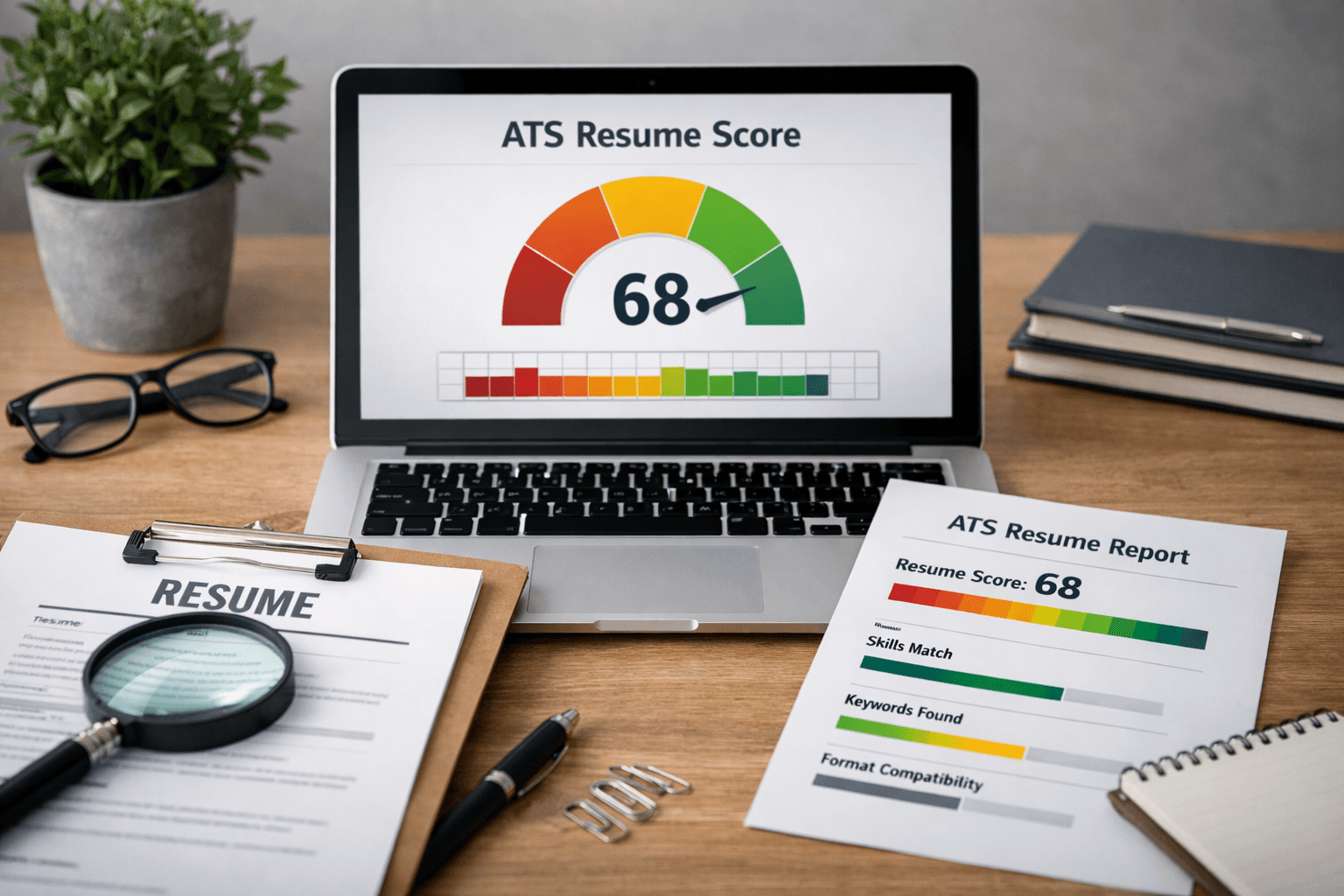
This is where the idea of an ATS score comes in. Think of it as a match percentage that shows how well your resume fits a specific job posting. The higher your score, the better your chances of getting noticed.
In this guide, we’ll break down what a good ATS score actually looks like—and more importantly, how you can improve yours without overcomplicating the process.

What Is an ATS Score (And How It’s Calculated)?
An ATS score is a numerical or percentage-based rating that shows how well your resume matches a specific job description. In simple terms, it measures how “relevant” your resume appears to an Applicant Tracking System based on what the employer is looking for. The closer your resume aligns with the job posting, the higher your score—and the better your chances of moving forward.
Most ATS platforms analyze resumes by scanning for patterns, keywords, and structure. They’re not judging you as a person; they’re evaluating how clearly your experience fits the role on paper. This means even small differences in wording or formatting can impact your score significantly.
Key Factors Behind ATS Scores
Keywords match
ATS systems look for exact or closely related keywords from the job description, including job titles, technical skills, tools, and certifications. Missing these can lower your score quickly.
Resume structure and formatting
Simple, clean layouts perform better. Complex designs, columns, or graphics may confuse the system and reduce readability.
Work experience relevance
Your past roles are evaluated based on how closely they match the responsibilities of the target job. Generic descriptions often underperform.
Education and qualifications
Degrees, certifications, and formal training are scanned to confirm baseline requirements for the role.
Factor | Why It Matters | Common Mistakes |
|---|---|---|
Keywords Match | Helps ATS identify relevance to the job description | Missing keywords or using uncommon synonyms |
Formatting & Structure | Ensures the system can properly read your resume | Using graphics, columns, or unusual layouts |
Work Experience Relevance | Shows alignment with role responsibilities | Vague descriptions or unrelated job details |
Education & Qualifications | Confirms you meet basic job requirements | Omitting certifications or key academic details |
It’s also worth noting that different ATS platforms, such as Workday or Greenhouse, may calculate scores slightly differently—so results can vary depending on the system being used.
So, What Is a “Good” ATS Score? (Real Benchmarks)
A “good” ATS score isn’t a fixed number—but there are realistic benchmarks that can help you understand where you stand. In general, an ATS score reflects how closely your resume matches a specific job description, and higher scores usually mean better chances of passing the initial screening.
Here’s a simple way to think about it:
80% and above is considered a strong match. At this level, your resume is highly aligned with the role, and you’re more likely to pass the ATS filter and reach a recruiter.
65% to 79% is decent but may need improvement. You’re on the right track, but missing keywords or weak alignment could still hold you back.
Below 65% is risky. Resumes in this range are more likely to be filtered out before a human ever sees them.
It’s important to note that most ATS systems don’t actually show you this score. Instead, what you see usually comes from third-party tools that simulate ATS behavior. While not perfect, they provide a helpful estimate.
Also, what counts as “good” can vary depending on the job. Competitive roles—like software engineering or data science—often require higher alignment, while entry-level or less technical roles may be more flexible.
ATS Score Range | Interpretation | Likely Outcome |
|---|---|---|
80% and above | Strong match | High chance of passing ATS screening |
65% – 79% | Moderate match | Possible shortlist with improvements |
Below 65% | Weak match | Likely filtered out early |
Why a High ATS Score Doesn’t Guarantee You the Job

Getting a high ATS score is a great start—but it’s only the first step in the hiring process. Applicant Tracking Systems are designed to filter resumes efficiently, not to make final hiring decisions. Once your resume passes this initial screening, it still needs to impress a human recruiter.
And this is where things often change. Recruiters don’t just look for keyword matches—they look for meaning. They want to understand your story, your impact, and how your experience translates into real value for the company.
What recruiters actually evaluate
Storytelling and impact
They want to see how your past work made a difference, not just what tasks you completed.
Clarity and achievements
Clear, concise bullet points with measurable results stand out far more than generic descriptions.
Cultural fit
Your tone, communication style, and overall profile should align with the company’s values and expectations.
One of the most common mistakes candidates make is keyword stuffing—adding as many keywords as possible without context. While this might improve your ATS score slightly, it often backfires when a recruiter reads your resume and finds it unnatural or vague.
The key takeaway is simple: optimizing for ATS is necessary, but not enough. You need a resume that works for both machines and humans.
5 Practical Ways to Improve Your ATS Score (Without Overthinking It)
Improving your ATS score doesn’t require a complete resume overhaul. In most cases, small, intentional changes can make a big difference. The key is to focus on alignment, clarity, and simplicity—without turning your resume into something unnatural.
1. Tailor Your Resume for Each Job
Instead of sending the same resume everywhere, adjust it based on the job description. Look for key skills, tools, and responsibilities, then reflect those naturally in your experience. This doesn’t mean copying and pasting—it means aligning your wording with what the employer is actually looking for.
2. Use Standard Section Headings
ATS systems are trained to recognize common headings like Work Experience, Skills, and Education. If you use creative alternatives like “What I’ve Done” or “My Expertise,” the system might not categorize your information correctly, which can lower your score.
3. Keep Formatting Simple
Clean formatting is essential. Stick to a single-column layout, standard fonts, and clear spacing. Avoid graphics, icons, or overly designed templates—they may look good visually but can confuse ATS systems and cause important information to be missed.
4. Focus on Relevant Achievements
Instead of listing generic responsibilities, highlight measurable results. For example, “Increased sales by 25%” or “Reduced processing time by 30%” gives both ATS and recruiters more meaningful signals about your impact.
5. Mirror the Job Description Language
Small wording changes can significantly improve your match rate. If the job description says “project management,” use that exact phrase instead of alternatives like “managing projects.” These subtle adjustments help ATS systems recognize your relevance more accurately.
Common ATS Mistakes That Kill Your Score
Even strong candidates can get filtered out by ATS systems because of avoidable mistakes. These issues often have nothing to do with your qualifications—they’re about how your resume is structured and written.
Over-designed resumes
Visually appealing resumes with graphics, icons, or multiple columns may look impressive to humans, but ATS systems can struggle to read them. Important information might get skipped or misinterpreted, lowering your score.
Missing keywords or using unrecognized synonyms
ATS systems rely heavily on exact keyword matching. If the job description says “data analysis” and your resume says “data interpretation,” the system may not recognize them as the same. Missing or mismatched keywords can significantly hurt your ranking.
Uploading the wrong file format
Not all file types are ATS-friendly. Image-based PDFs or heavily formatted documents can prevent the system from properly scanning your content. In most cases, a clean .docx or text-based PDF works best.
Using vague descriptions instead of concrete skills
Generic phrases like “responsible for tasks” don’t provide enough detail for ATS systems or recruiters. Specific, skill-based language performs much better.
Bad Example | Improved Version |
|---|---|
Responsible for managing projects | Managed 5+ cross-functional projects from start to finish |
Worked on data tasks | Performed data analysis using SQL and Python |
Helped increase sales | Increased sales by 20% within 6 months |
Assisted team with reports | Created weekly performance reports using Excel |
Avoiding these common mistakes can instantly improve how your resume is interpreted—without changing your actual experience.
How to Check Your ATS Score (Tools & Methods)
If you want to improve your ATS score, the first step is knowing where you stand. While most companies don’t show your actual ATS score, there are plenty of resume scanners and simulators that give you a close estimate. These tools compare your resume against a job description and highlight gaps in keywords, structure, and relevance.
The process is usually simple and repeatable, making it easy to refine your resume over time.
A simple workflow you can follow
Step 1: Paste the job description
Copy the full job posting into the tool so it knows what to benchmark against.
Step 2: Scan your resume
Upload your resume and let the system analyze how well it matches the role.
Step 3: Adjust keywords and structure
Use the feedback to improve alignment—add missing keywords, simplify formatting, and refine your experience descriptions.
Most tools provide a match score, keyword suggestions, and formatting tips. While they may not perfectly reflect how every ATS works, they’re useful for identifying obvious gaps and improving your chances.
Where Sensei AI Fits
While ATS tools focus on resume screening, Sensei AI comes into play later in the hiring process. Its AI Playground feature can help you refine how you present your experience, whether you're improving resume bullet points or preparing stronger interview answers. It’s a practical way to turn a well-optimized resume into clear, confident communication.
Try Sensei AI for Free
From Resume to Interview: Why ATS Optimization Is Only Step One
Getting past the ATS is an important milestone—but it’s just the beginning. Once your resume clears the initial screening, your application moves into the hands of a recruiter or hiring manager. At this stage, the focus shifts from matching keywords to demonstrating real value.
In other words, passing the ATS gets your foot in the door—but it doesn’t guarantee anything beyond that. You now face a new challenge: answering interview questions clearly, confidently, and in a way that connects your experience to the role.
This is where many candidates struggle. A resume can be carefully optimized and polished, but if you can’t explain your achievements, decisions, and thought process during an interview, it becomes much harder to stand out. Employers are looking for more than qualifications—they want communication, clarity, and problem-solving ability.
Where Sensei AI Fits
Sensei AI supports you during real interviews by detecting interviewer questions and generating answers in real time. By referencing your uploaded resume and role-specific details, it provides personalized responses that align with your background. This helps bridge the gap between having a strong resume and delivering strong interview answers.
Practice with Sensei AI
How Resume Quality Impacts Your Interview Performance
Your resume doesn’t just help you get the interview—it actively shapes how the interview unfolds. Recruiters and hiring managers often base their questions directly on what they see in your resume, from your listed skills to your past achievements. This means the way you present your experience can influence both the direction and depth of the conversation.
When your resume is well-optimized for ATS and clearly aligned with the job description, you’re more likely to receive relevant and targeted questions. Instead of being asked to explain gaps or vague responsibilities, you’ll be invited to expand on specific skills and accomplishments that already match the role.
There’s also a direct link between resume clarity and your confidence during interviews. If your experience is structured clearly—with defined outcomes and measurable results—it becomes much easier to talk about it under pressure. You’re not trying to “figure out” your story on the spot; you’re simply expanding on what’s already well-articulated.
That’s why preparation shouldn’t stop at the document itself. A strong resume sets the foundation, but practicing how you explain and connect your experience is what ultimately determines how well you perform in the interview.
Bonus: Should You Aim for 100% ATS Score?
Short answer: aiming for a perfect 100% ATS score is usually unnecessary—and sometimes counterproductive. While it might seem like hitting every keyword would guarantee success, the reality is that over-optimization can backfire.
Diminishing returns
Once your resume hits around 80–85% alignment with a job description, additional gains become minor. Spending excessive time chasing 100% often takes away from improving clarity, storytelling, and readability—elements that actually matter to human reviewers.
Over-optimization risks
Keyword stuffing or forcing unnatural phrases can make your resume awkward to read. Recruiters may notice vague, repetitive, or mechanical language, which undermines the professionalism and impact of your experience.
Ideal strategy
Focus on hitting a strong match level, then shift attention to structuring achievements clearly and using concise, impactful language. This approach balances ATS compatibility with human readability, giving you the best chance to progress through both automated screening and real interviews.
Aim for Smart Optimization, Not Perfection

The main takeaway is simple: targeting a strong ATS match—generally 80% or higher—is important, but it’s equally crucial to make your resume clear, readable, and impactful for human eyes. Striking a balance between being ATS-friendly and human-friendly ensures your application passes the initial filter and sets the stage for effective interviews.
Remember, your resume is only one step in the hiring process. Optimizing it smartly gives you an edge, but preparation for interviews, storytelling, and clear communication are what ultimately determine success.
After your resume helps you get through the ATS, Sensei AI can assist during actual interviews by detecting questions and providing real-time answers. By personalizing responses using your resume and role-specific details, it supports candidates in turning a strong application into confident interview performance.
Try Sensei AI Now!
FAQs
Is 72 a good ATS score?
A score of 72 is generally considered moderate. It indicates that your resume passes many Applicant Tracking System (ATS) filters but may need optimization for keywords, formatting, and clarity to increase the likelihood of being noticed by recruiters.
Is ATS score 85 good?
An ATS score of 85 is strong. It suggests that your resume is well-optimized for both keywords and formatting, and has a high chance of passing ATS scans for most job applications.
Is 87% a good ATS score?
An 87% ATS score is very good. Resumes in this range typically match most of the job description requirements and are likely to make it through ATS filters successfully.
Is a 2 page CV ATS friendly?
Yes, a 2-page CV can be ATS-friendly as long as it follows these guidelines:
Use standard headings (e.g., Experience, Education, Skills).
Avoid complex tables, images, or graphics that ATS may not parse correctly.
Keep formatting simple and consistent.
Focus on relevant keywords and clear structure.

Shin Yang
Shin Yang is a growth strategist at Sensei AI, focusing on SEO optimization, market expansion, and customer support. He uses his expertise in digital marketing to improve visibility and user engagement, helping job seekers make the most of Sensei AI's real-time interview assistance. His work ensures that candidates have a smoother experience navigating the job application process.
Learn More
Tutorial Series: Introducing Our New Chrome Extension Listener
Sensei AI vs Interviewing.io: Which Interview Tool Is Better for You in 2026?
Sensei AI vs Huru: Which AI Interview Tool Is Better in 2026?
Sensei AI vs Interview Warmup: Which Interview Practice Tool Is Better in 2026?
How Recruiters Detect AI Answers (and How to Stay Authentic)
Interview Copilot vs Traditional Interview Coaching: Which Is Better for Your Next Interview?
Best AI for Behavioral Interview Questions: 9 Tools to Practice Smarter in 2026
Google Interview Warmup Alternatives: 9 Best Tools to Practice for Interviews in 2026
How to Practice for an Interview by Yourself: A Step-by-Step Guide That Actually Works
Best AI Tools for Job Seekers in 2026
Sensei AI
hi@senseicopilot.com