

Why AI Resume Scoring Matters More Than Ever
Not long ago, getting your resume noticed meant impressing a human recruiter within a few seconds. Today, the process looks very different. Most job applications are now filtered by AI systems before a recruiter ever sees them. According to industry research from LinkedIn and Jobscan, a large majority of companies now use Applicant Tracking Systems (ATS) to screen resumes early in the hiring process, with estimates commonly ranging above 70% to 90% depending on company size and industry.
So what exactly are AI resume scoring systems? In simple terms, they are software tools that scan, analyze, and rank resumes based on how well they match a specific job description. Instead of relying on human intuition, these systems use structured criteria like keywords, experience, and relevance to determine whether your resume moves forward.
The good news is that these systems are not impossible to navigate. Once you understand how they work, you can adjust your resume in a way that improves your chances—without resorting to tricks or keyword stuffing.
In the next section, we will take a closer look at what is really happening behind the scenes when your resume gets scanned.

What Is an AI Resume Scoring System?
An AI resume scoring system is a type of software used by companies to evaluate and rank job applications automatically. It is usually part of a larger Applicant Tracking System (ATS), which manages the entire hiring workflow—from collecting resumes to shortlisting candidates. Popular ATS platforms such as Workday, Greenhouse, iCIMS, Lever, and SAP SuccessFactors all include resume parsing and candidate ranking features in some form.
At a basic level, these systems take your resume and convert it into structured data. This process is called parsing. The AI extracts key details such as your skills, work experience, education, and job titles, and then compares them against the job description. Based on predefined criteria—like keyword relevance, experience level, and role alignment—the system assigns your resume a score or ranking.
This score helps recruiters quickly identify which candidates are the best match, saving them time and reducing manual effort. Instead of reading hundreds of resumes, they focus only on the highest-ranked ones.
Simple Example of Resume Scoring
Imagine a job posting that requires Python, SQL, and at least 3 years of experience. If your resume clearly includes all three, you might receive a high match score, such as 85% or above. Another candidate who only mentions Python but lacks SQL or sufficient experience might receive a much lower score, even if they are otherwise qualified.
This is why understanding how scoring works is so important—it directly affects whether your resume gets seen at all.
How AI Resume Scoring Systems Actually Work (Step-by-Step)
Understanding how AI resume scoring works can make the process feel much less mysterious. While different platforms may vary slightly, most systems follow a similar step-by-step workflow when evaluating your resume.
Step 1: Resume Parsing
The first step is parsing. This is where the system scans your resume and converts it into structured data. It identifies sections like work experience, education, skills, and certifications, then organizes that information into categories. For example, it can recognize job titles, extract company names, and detect dates of employment. Clean formatting helps ensure that nothing important gets missed during this stage.
Step 2: Keyword Matching
Next comes keyword matching. The system compares your resume against the job description to find overlapping terms. If a role requires skills like project management, SQL, or digital marketing, the AI will look for those exact or closely related keywords in your resume. The more relevant matches it finds, the stronger your alignment score becomes.
Step 3: Context and Semantic Matching
Modern systems go beyond simple keyword matching by using Natural Language Processing (NLP). This allows the AI to understand context and recognize similar meanings. For example, it can identify that “data analysis” and “data analytics” are closely related, even if the wording is not identical. This reduces the need for exact keyword duplication while still rewarding relevant experience.
Step 4: Scoring and Ranking
Finally, the system assigns a score based on multiple factors such as keyword relevance, experience level, and overall alignment with the job requirements. Some elements may carry more weight than others, depending on the role. Your resume is then ranked against other applicants, helping recruiters prioritize who to review first.
While this scoring determines whether you get shortlisted, the next challenge is performing well in the interview. This is where tools like Sensei AI can help by generating real-time answers based on your resume and the role context as interview questions are asked.
Try Sensei AI for Free
What Factors Influence Your Resume Score?
Not all resumes are evaluated equally. AI resume scoring systems rely on several key factors to determine how well your application matches a job description. Understanding these factors can help you make smarter, more targeted improvements.
1. Keyword Relevance
Keywords are one of the most important signals. These are typically pulled directly from the job description, including required skills, tools, and qualifications. If your resume uses similar language, your chances of scoring higher increase significantly. However, the goal is natural alignment, not forced repetition.
2. Experience Alignment
It is not just about how much experience you have, but how relevant it is. A candidate with three years of directly related experience may rank higher than someone with five years in an unrelated field. AI systems prioritize quality and relevance over sheer volume.
3. Skills Placement
Where you place your skills also matters. Skills listed in clearly labeled sections like “Skills” or “Core Competencies” are easier for AI to detect. Burying important skills inside paragraphs can reduce their visibility during parsing.
4. Formatting and Readability
Simple, clean formatting improves your score. Complex designs, graphics, or unusual layouts can confuse parsing systems, causing important information to be missed or misinterpreted. Standard headings and consistent structure work best.
5. Job Title Matching
Job titles play a bigger role than many candidates expect. If your previous roles closely match the target position title, it signals stronger alignment. Even small differences in wording can affect how your experience is interpreted.
High vs Low Scoring Resume Elements
Factor | High Score Example | Low Score Example |
|---|---|---|
Keyword Relevance | Uses exact terms from job description naturally | Uses vague or unrelated terms |
Experience Alignment | Relevant roles with similar responsibilities | Unrelated experience with no clear connection |
Skills Placement | Skills listed in a dedicated, clear section | Skills hidden inside long paragraphs |
Formatting | Clean layout with standard headings | Overdesigned resume with graphics and columns |
Job Title Matching | Titles closely match target role | Titles are vague or significantly different |
The key takeaway is simple: clarity and alignment matter more than creativity. A well-structured, relevant resume will consistently outperform one that looks impressive but is harder for AI to understand.
Common Mistakes That Lower Your Score
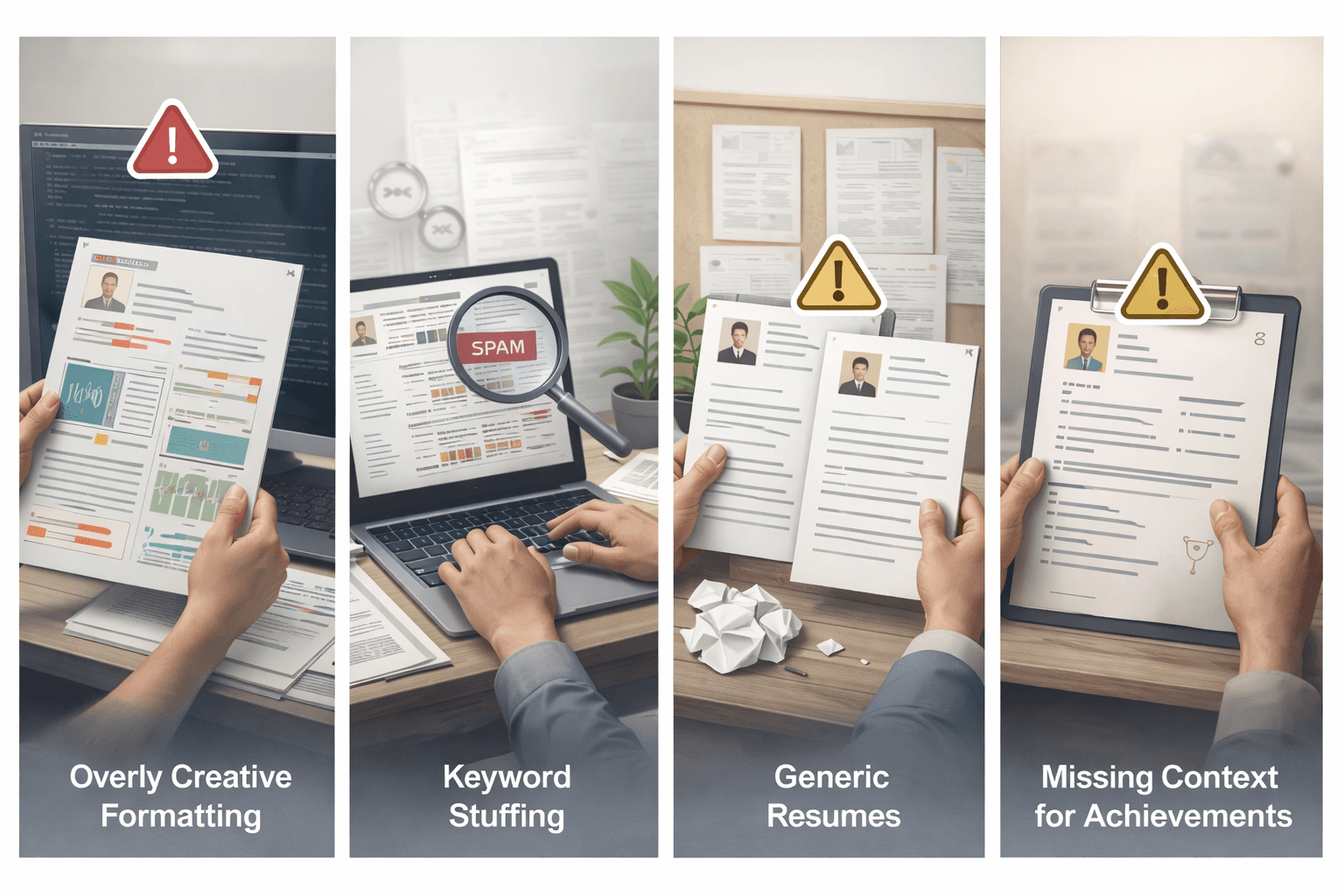
Even strong candidates can get filtered out by AI resume scoring systems due to avoidable mistakes. Understanding these common issues can help you prevent unnecessary score drops and improve your chances of getting shortlisted.
Overly Creative Formatting
While visually appealing resumes may stand out to humans, they often confuse AI systems. Designs with multiple columns, graphics, icons, or unusual fonts can break the parsing process. When the system cannot properly read your information, key details like skills or experience may be ignored entirely.
Keyword Stuffing
It might seem like adding as many keywords as possible would boost your score, but this can backfire. AI systems are increasingly capable of detecting unnatural repetition. Overloading your resume with keywords without proper context can reduce readability and even lower your ranking.
Generic Resumes
Submitting the same resume for every job is one of the most common mistakes. AI scoring systems are designed to measure alignment with a specific role. A generic resume that does not reflect the job description will almost always rank lower than a tailored one.
Missing Context for Achievements
Simply listing responsibilities is not enough. AI systems look for evidence of impact. Statements without measurable results or clear outcomes provide less value and may weaken your overall score compared to candidates who show specific achievements.
Even after your resume passes AI screening, the next challenge is clearly communicating your experience in interviews. Many candidates struggle with this transition. Tools like Sensei AI use your resume as context to generate structured, real-time answers when interviewers ask questions, helping you stay consistent and relevant under pressure.
Practice with Sensei AI
How to Optimize Your Resume for AI Scoring (Without Over-Optimizing)
Improving your resume for AI scoring does not mean turning it into a keyword-heavy document. The goal is to create a clear, relevant, and structured resume that aligns naturally with the job you are applying for.
Tailor Each Resume to the Job Description
One of the most effective strategies is customization. Carefully read the job description and adjust your resume to reflect the specific skills, tools, and experience required. Even small wording changes can improve alignment and increase your match score.
Use Natural Keyword Placement
Keywords should be integrated naturally into your resume, especially in your experience and skills sections. Instead of listing terms randomly, include them in meaningful sentences that demonstrate how you have applied those skills in real situations.
Focus on Measurable Results
AI systems prioritize impact. Instead of simply describing your responsibilities, highlight measurable outcomes. For example, mention how you increased sales, reduced costs, or improved efficiency. Numbers and results make your experience more concrete and valuable.
Keep Formatting ATS-Friendly
Stick to a clean and simple layout. Use standard fonts, avoid graphics or tables, and keep your structure easy to follow. This ensures that the system can accurately parse your information without errors.
Use Standard Section Headings
Clear headings like “Work Experience,” “Education,” and “Skills” help AI systems quickly identify key information. Avoid creative alternatives that may confuse the parsing process.
Quick Optimization Checklist
Before submitting your resume, make sure it clearly reflects the job description, uses relevant keywords in a natural way, highlights measurable achievements, maintains a simple and readable format, and includes standard section headings that are easy for AI systems to recognize.
Can You “Beat” AI Resume Scoring Systems?
It is tempting to think of AI resume scoring as a system you can “hack” or outsmart. Many job seekers try to game the system by stuffing keywords, copying job descriptions, or exaggerating skills. While these tactics may have worked in the past, modern AI systems are far more advanced and can detect patterns that feel unnatural or inconsistent.
Today’s systems are designed to reward relevance and clarity, not manipulation. They evaluate how well your experience aligns with the role, not just how many keywords you include. Over-optimization can actually hurt your chances by making your resume harder to read or less credible. Recruiters who review top-ranked resumes can quickly spot when something feels off.
The better approach is to focus on genuine alignment. Use clear language, highlight real achievements, and tailor your resume thoughtfully for each role. This not only improves your AI score but also ensures your resume holds up when a human reviews it.
Getting past AI filters is only the first step. Once you reach the interview stage, your ability to communicate your experience becomes critical. Tools like Sensei AI can support this by listening to interviewer questions and generating tailored responses instantly based on your resume, helping you stay accurate and confident in real time.
Try Sensei AI Today!
The Role of AI in the Full Hiring Funnel
AI is not limited to resume screening. It is now embedded across nearly every stage of the hiring process, helping companies move faster while maintaining consistency in candidate evaluation. From initial application to final decision-making, AI tools are shaping how candidates are assessed.
Many companies use AI-powered video interview platforms such as HireVue to analyze candidate responses, communication style, and in some cases facial expressions. Assessment platforms like Pymetrics use behavioral science and game-based evaluations to measure cognitive abilities and personality traits. These tools help employers gain deeper insights beyond what a resume alone can provide.
Automation is also becoming more common. Scheduling interviews, sending follow-ups, and even ranking candidates can now be handled by AI systems, reducing manual workload for recruiters and speeding up the hiring timeline.
From Resume to Interview to Offer
Each stage of the hiring funnel uses AI differently. During the resume stage, AI focuses on matching qualifications and filtering candidates. In the interview stage, it evaluates communication, responses, and problem-solving ability. At the final stage, AI may assist in comparing candidates and predicting job fit.
Understanding this full pipeline helps you prepare more effectively, not just for getting noticed, but for succeeding at every step of the hiring process.
Should You Use AI to Build Your Resume?
AI tools have made resume creation faster and more accessible than ever. With just a few inputs, you can generate a complete draft in seconds. However, while AI can be a powerful assistant, it is not a complete replacement for thoughtful, human input.
Where AI Helps
AI is especially useful for getting started. It can help you structure your resume, suggest professional wording, and highlight skills you may have overlooked. For job seekers who are unsure how to phrase their experience, AI provides a strong foundation and saves time. It can also help refine grammar, improve clarity, and ensure your resume looks polished.
Where You Still Need Human Input
Despite its strengths, AI lacks personal context. It does not fully understand your unique achievements, career goals, or the nuances of your experience. Relying entirely on AI-generated content can result in a resume that feels generic or lacks authenticity. You still need to review, edit, and tailor the content to ensure it accurately reflects your background and aligns with the job you want.
Sensei AI’s AI Playground can also be used to brainstorm interview or career-related questions in a conversational way, helping you think through your responses more clearly. Its AI Editor can generate a resume draft from your inputs, but it works best when you refine and personalize the final version.
Try Sensei Ai Now!
Focus on Clarity, Not Tricks

AI resume scoring systems are not something to fear, but something to understand. Once you know how they evaluate resumes, the process becomes much more predictable and manageable, rather than intimidating or random.
The key takeaway is that success does not come from trying to “hack” the system. Instead, it comes from alignment, clarity, and relevance. A well-structured resume that clearly reflects your skills and experience will always perform better than one filled with tricks or over-optimization.
As hiring continues to evolve with AI, candidates who focus on clear communication and genuine experience will consistently stand out. With the right approach, you can improve not only your resume score but also your confidence and performance throughout the entire hiring process.
FAQs
What is an AI resume scoring system?
An AI resume scoring system is software used by employers to automatically evaluate resumes by comparing them against job descriptions. It ranks candidates based on skills, experience, and keyword relevance before a human recruiter reviews them.
How do ATS systems rank resumes?
ATS systems rank resumes by parsing content, extracting keywords, and scoring how closely a candidate matches the job requirements. Higher alignment with required skills and experience results in a higher ranking.
How can I improve my resume score in ATS?
You can improve your ATS score by tailoring your resume to each job description, using relevant keywords naturally, highlighting measurable achievements, and keeping formatting simple and readable.
Can AI reject your resume?
Yes. If your resume lacks relevant keywords, has poor formatting, or does not match the job requirements, AI systems may filter it out before it reaches a recruiter.

Shin Yang
Shin Yang est un stratégiste de croissance chez Sensei AI, axé sur l'optimisation SEO, l'expansion du marché et le support client. Il utilise son expertise en marketing numérique pour améliorer la visibilité et l'engagement des utilisateurs, aidant les chercheurs d'emploi à tirer le meilleur parti de l'assistance en temps réel aux entretiens de Sensei AI. Son travail garantit que les candidats ont une expérience plus fluide lors de la navigation dans le processus de candidature.
En savoir plus
Série de tutoriels : Présentation de notre nouvelle extension Chrome Listener
Sensei AI vs Interviewing.io: Which Interview Tool Is Better for You in 2026?
Sensei AI vs Huru: Which AI Interview Tool Is Better in 2026?
Sensei AI vs Interview Warmup: Which Interview Practice Tool Is Better in 2026?
How Recruiters Detect AI Answers (and How to Stay Authentic)
Interview Copilot vs Traditional Interview Coaching: Which Is Better for Your Next Interview?
Best AI for Behavioral Interview Questions: 9 Tools to Practice Smarter in 2026
Google Interview Warmup Alternatives: 9 Best Tools to Practice for Interviews in 2026
How to Practice for an Interview by Yourself: A Step-by-Step Guide That Actually Works
Best AI Tools for Job Seekers in 2026
Sensei AI
hi@senseicopilot.com