
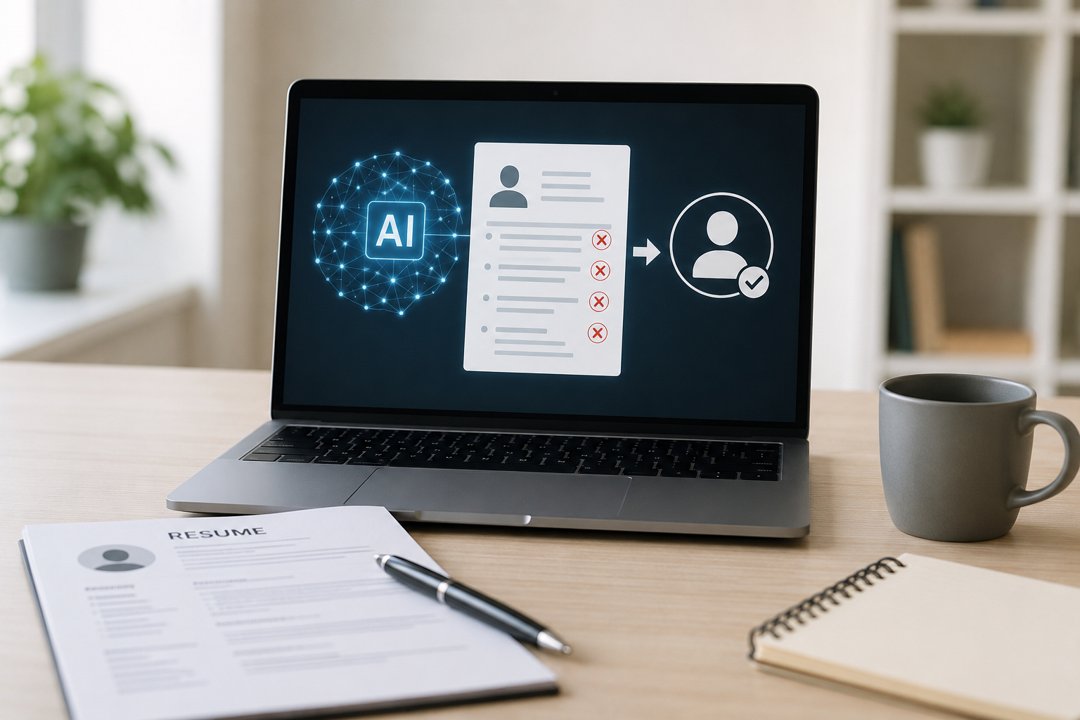
Your resume may be rejected before a recruiter has spent more than a few seconds looking at it—and in some cases, before a human has looked at it at all. As companies receive hundreds or even thousands of applications for a single opening, many now rely on AI-powered screening tools alongside recruiters to sort, organize, and prioritize candidates more efficiently. That means your resume often has to make a strong first impression twice: once with technology and again with a hiring professional.
The good news is that AI and recruiters aren't looking for exactly the same things. AI focuses on patterns, structure, consistency, and how well your resume matches the job description, while recruiters pay closer attention to your career story, achievements, and overall fit for the role. Understanding both perspectives gives you a significant advantage because a resume that performs well in both stages is much more likely to move forward.
In this guide, you'll learn the most common resume mistakes AI notices before humans do, why they matter, and how to fix them with simple, practical changes. Instead of diving into complicated technical details, we'll focus on actionable improvements that can help your resume stand out for the right reasons.
How AI Looks at Your Resume Differently Than Recruiters
Artificial intelligence doesn't evaluate resumes the same way people do. It doesn't decide whether you're ambitious, confident, or a good cultural fit. Instead, it analyzes patterns, structure, consistency, keywords, and whether important information is present and easy to interpret. Before considering the quality of your experience, AI first checks whether your resume can be read accurately and whether it appears relevant to the position.
Recruiters, on the other hand, look beyond technical details. Once your resume reaches their desk, they're trying to understand your career journey, the impact you've made, how your experience aligns with the role, and whether your accomplishments tell a compelling professional story. They also pay attention to communication style, clarity, and overall presentation.
This difference explains why a resume that looks attractive to a person isn't always optimized for automated screening. If the formatting confuses the software or the right keywords are missing, your application may rank lower before a recruiter ever has the chance to review it. Passing AI screening doesn't automatically earn you an interview, but failing it can prevent your resume from reaching the human decision-maker in the first place.
AI Notices First | Recruiters Notice Later |
|---|---|
Keywords | Career progression |
Resume structure | Achievements |
Job title relevance | Communication skills |
Formatting consistency | Professionalism |
Missing information | Overall impression |
Resume Mistakes AI Notices Before Humans Do
Most resumes aren't rejected because of one major flaw. Instead, they're held back by several small issues that add up over time. A missing keyword here, an inconsistent date there, or an overly designed layout might not seem like a big deal individually. However, together they can make your resume harder for AI to understand and less convincing to recruiters. The good news is that these mistakes are usually easy to fix once you know what to look for.
Missing the Keywords That Match the Job Description
One of the most common mistakes is submitting the same resume for every application. AI screening tools compare your resume against the language used in the job description, looking for relevant skills, technologies, certifications, and job titles. If important terms are missing, your resume may appear less relevant even if you have the right experience.
For example:
Less effective:
Managed business software.
Worked with customer data.
More effective:
Managed Salesforce CRM to improve customer relationship management.
Analyzed customer data using SQL and Microsoft Excel.
The goal isn't to stuff your resume with keywords. Instead, naturally incorporate the terms that accurately describe your experience. Before submitting any application, review the job description and adjust your resume so the wording reflects the employer's priorities while remaining honest and readable.
Using Fancy Resume Designs That Machines Can't Read
A visually impressive resume isn't always a machine-friendly one. Many AI screening systems perform best with clean, straightforward layouts, while overly creative designs can make important information difficult to extract.
Common formatting elements that may create problems include:
Icons beside section headings
Text boxes
Multi-column layouts
Decorative graphics
Embedded charts or skill bars
Simple formatting often performs better because AI can clearly identify headings, dates, job titles, and bullet points without guessing where information belongs. A professional resume doesn't need elaborate design—it needs clarity. A single-column layout with standard fonts, consistent headings, and plenty of white space is usually the safest choice for both AI systems and recruiters.
Generic Job Titles That Hide Your Experience
Your job title provides valuable context, but generic titles can make it difficult for AI to understand your background. Titles such as Specialist, Coordinator, or Consultant don't always communicate your actual responsibilities or expertise.
Whenever appropriate, use a more descriptive title that aligns with industry terminology while remaining truthful.
For example:
Customer Success Specialist → Customer Success Manager
Marketing Coordinator → Digital Marketing Coordinator
IT Consultant → Cybersecurity Consultant
If your official internal title was unusually broad, you can clarify it by adding a more recognizable industry description in parentheses when appropriate. This helps both AI and recruiters quickly understand your experience without changing the facts of your employment.
Listing Responsibilities Instead of Results
Many resumes describe what someone was expected to do instead of what they actually accomplished. AI increasingly recognizes measurable achievements, and recruiters certainly appreciate evidence of impact.
Compare these examples:
Responsibility-focused:
Managed social media accounts.
Assisted with project planning.
Handled customer inquiries.
Results-focused:
Increased LinkedIn engagement by 42% within six months.
Coordinated a cross-functional project delivered two weeks ahead of schedule.
Maintained a 97% customer satisfaction rating while resolving over 50 inquiries per day.
Whenever possible, include numbers, percentages, revenue, cost savings, efficiency improvements, or other measurable outcomes. Even approximate metrics are often more persuasive than a list of daily responsibilities because they demonstrate the value you brought to previous employers.
Inconsistent Dates and Employment History
Employment history should be easy to follow. Inconsistent formatting can confuse both AI systems and recruiters, making your career timeline appear less reliable than it actually is.
Watch for issues such as:
Mixing formats like "2022–Present" and "Jan 2021 - December 2022"
Omitting months for some positions but not others
Overlapping employment dates without explanation
Leaving noticeable career gaps unexplained
Choose one date format and use it consistently throughout your resume. If you took time off for education, caregiving, freelancing, or professional development, briefly explaining the gap is often better than leaving recruiters to make assumptions.
Overusing Buzzwords Without Evidence
Words like team player, innovative, strategic thinker, and results-driven appear on countless resumes. While these qualities are valuable, simply claiming them doesn't make your application stronger.
Instead of writing:
Team player
Innovative
Strategic thinker
Results-driven
Show evidence that supports those qualities.
For example:
Collaborated with five departments to launch a new customer onboarding process.
Developed an automated reporting workflow that reduced weekly reporting time by 35%.
Led quarterly planning meetings that improved project delivery consistency.
Specific examples carry much more weight than generic adjectives because they demonstrate your abilities rather than simply describing them.
Skills Section Doesn't Match the Rest of the Resume
Your skills section should reinforce the experience described elsewhere in your resume. If AI sees advanced skills listed without supporting evidence in your work history or projects, those claims may appear less credible.
Review your resume for consistency across:
Skills
Professional experience
Projects
Certifications
For example, if you list Python, Power BI, or Google Analytics as key skills, those tools should ideally appear within relevant work experience, project descriptions, or certifications. Consistency makes your resume more believable and helps recruiters quickly connect your skills with real-world accomplishments.
Including Too Much Irrelevant Information
Trying to include everything you've ever done can weaken your resume instead of strengthening it. AI values relevance, and recruiters have limited time to review each application.
Consider removing or minimizing information such as:
Software that is rarely used today
Expired or outdated certifications
Hobbies unrelated to the position
Jobs from more than 15 years ago that don't support your current career goals
Your resume should focus on the experience that best matches the role you're applying for. Prioritizing relevant achievements over exhaustive history creates a clearer, stronger application that is easier for both AI systems and recruiters to understand.
Mistakes Humans Still Notice After AI Passes Your Resume
Getting through AI screening is an important milestone, but it isn't the finish line. Once your resume reaches a recruiter or hiring manager, it is evaluated from a completely different perspective. Humans look for context, credibility, and evidence that you'll succeed in the role—not just whether your resume contains the right keywords. That's why a resume should be optimized for both technology and people.
Weak Professional Summary
A professional summary is often the first section recruiters read, yet many candidates waste the opportunity with generic statements that could apply to almost anyone.
For example, a summary like "Motivated professional with excellent communication skills seeking new opportunities" doesn't explain what you do or why you're qualified.
Instead, clearly communicate your expertise, years of experience, industry focus, and strongest value. A recruiter should immediately understand who you are and what you can contribute within just a few lines.
Poor Storytelling
Recruiters don't simply read job titles—they look for the story behind your career. If your resume jumps between positions without explanation, omits promotions, or fails to show increasing responsibility, your experience may seem less impressive than it actually is.
Help readers connect the dots by presenting a logical career progression. If you were promoted, took on leadership responsibilities, managed larger projects, or shifted into a new specialization, make those milestones visible. Context helps recruiters understand not only where you've worked but also how your career has developed over time.
Achievements Without Business Impact
Strong resumes don't stop at listing accomplishments—they explain why those accomplishments mattered.
For example, saying you implemented a new reporting system is informative, but explaining that it reduced reporting time by 40% and improved decision-making across three departments demonstrates real business value.
Recruiters want to understand the outcomes behind your work. Whenever possible, connect your achievements to measurable improvements such as increased revenue, lower costs, higher customer satisfaction, faster processes, improved productivity, or reduced risk. Showing impact makes your contributions far more memorable.
Inconsistent Tone
A resume should feel like it was written by one person with one clear voice. Mixing writing styles can make the document appear rushed or poorly edited.
Common examples include:
Writing formal, detailed descriptions for one position but using short, casual phrases for another.
Switching between first-person language and implied third-person writing.
Mixing complete sentences with fragmented bullet points.
Alternating between highly technical language and overly conversational wording without a clear reason.
Aim for consistent grammar, formatting, and tone throughout your resume. Every section should feel cohesive and equally polished.
AI may open the door by helping your resume reach a recruiter, but people ultimately decide who receives an interview invitation. A resume that combines strong AI optimization with clear storytelling, meaningful achievements, and consistent writing gives you the best chance of moving to the next stage of the hiring process.
A Practical Resume Review Checklist Before Every Application
Before you click Submit, take a few minutes to review your resume one last time. Even a well-written resume can contain small issues that reduce its effectiveness. A consistent review process helps you catch avoidable mistakes, improve readability, and ensure your resume is ready for both AI screening systems and human recruiters.
Check | Why It Matters |
|---|---|
Matches job description keywords | Improves search relevance and demonstrates alignment with the role. |
Standard section headings | Makes the resume easier for AI systems to parse accurately. |
Consistent dates | Builds trust and creates a clear employment timeline. |
Quantified achievements | Adds credibility by showing measurable results. |
Relevant skills only | Keeps your resume focused on the position you're applying for. |
Grammar checked | Creates a professional first impression and reduces distractions. |
File format verified | Helps avoid formatting or upload issues during the application process. |
Contact information updated | Prevents recruiters from missing opportunities to reach you. |
Spending just 10 to 15 minutes reviewing these items before every application can make a meaningful difference. Small corrections—such as updating keywords, fixing date inconsistencies, or replacing vague statements with measurable achievements—can improve both AI readability and recruiter confidence. Rather than relying on one master resume for every job, treat each application as an opportunity to fine-tune your content for a better match.
After refining your resume, some job seekers also use the AI Editor in Sensei AI to quickly generate or polish resume content based on their own experience before making final edits themselves. It's a simple way to speed up the drafting process, while the final review should always ensure the resume accurately reflects your background and matches the specific role you're targeting.
Try Sensei AI for Free
Use AI for More Than Resume Writing
A polished resume can help you secure an interview, but it's only one step in the hiring process. Once you're invited to speak with a recruiter or hiring manager, your ability to explain your experience, answer behavioral questions, discuss technical topics, and communicate confidently becomes just as important. Preparing for interviews requires a different set of skills than writing a resume, which is why many job seekers use AI throughout their entire job search instead of only during the application stage.
One example is the AI Playground in Sensei AI, where you can have natural conversations about interview preparation, resume improvements, salary negotiations, workplace situations, and other career-related questions. Rather than searching through dozens of articles, you can ask follow-up questions, explore different scenarios, and refine your responses in an interactive way as you prepare for upcoming opportunities.
When it's time for the actual interview, Sensei AI serves as an interview copilot by listening to interview questions and generating personalized responses in real time based on your resume and any additional information you've uploaded. Because the answers are grounded in your own background instead of generic examples, they can better reflect your experience and help you stay consistent throughout the conversation.
Try Sensei AI Now!
Final Thoughts
AI resume screening isn't something job seekers should fear—it's simply another part of today's hiring process. The encouraging news is that most of the issues AI identifies are completely preventable. Clear formatting, relevant keywords, measurable achievements, consistent dates, and accurate information can all make your resume easier for software to process while also making it more convincing for recruiters.
Instead of treating your resume as a document you create once and never revisit, make it a habit to review and adjust it before every application. Spending a few extra minutes tailoring your resume to the specific role can significantly improve its relevance and help highlight the experience that matters most to each employer.
Remember that getting past AI isn't the ultimate goal. A successful resume is one that communicates your value clearly to both technology and people. When your resume is easy for AI to read and compelling for recruiters to review, you give yourself the best possible chance of earning more interviews and moving one step closer to your next opportunity.
FAQs
Can AI reject my resume before a recruiter sees it?
Yes, in many organizations, your resume is reviewed by an Applicant Tracking System (ATS) or AI-assisted screening software before a recruiter manually evaluates it. These systems may organize, score, rank, or filter applications based on factors such as keyword relevance, job title alignment, required skills, education, and resume structure. While AI doesn't always make the final hiring decision, a poorly optimized resume may receive a lower ranking, reducing the likelihood that a recruiter reviews it promptly. That's why creating a machine-readable resume is an important first step.
Should every resume be customized for each job application?
In most cases, yes. Every job description emphasizes different skills, responsibilities, and qualifications. Tailoring your resume allows you to highlight the experience that best matches each position while naturally incorporating relevant keywords. Customization doesn't mean rewriting your entire resume from scratch. Small adjustments to your professional summary, skills section, achievements, and wording are often enough to improve relevance and demonstrate a stronger fit for the role.
Are resume templates bad for AI screening?
Not at all. Many simple, professionally designed templates work perfectly with modern ATS and AI systems. Problems usually arise when templates rely heavily on graphics, text boxes, icons, multi-column layouts, decorative elements, or embedded charts. These features can make information harder for software to interpret correctly. If you're unsure, choose a clean, single-column template with clear section headings and consistent formatting.
What file format is safest for submitting a resume?
Both PDF and DOCX are widely accepted by employers today. PDF files preserve formatting across different devices, while DOCX files may be preferred by some older applicant tracking systems. The safest approach is to carefully follow the employer's application instructions. If a specific file format is requested, always use it. When no preference is provided, a well-formatted PDF is generally a reliable choice because it maintains a consistent appearance.
How often should I update my resume?
You don't need to wait until you're actively searching for a new job. Update your resume whenever you complete a major project, earn a certification, receive a promotion, learn a valuable new skill, or achieve measurable results worth highlighting. Keeping your resume current makes future applications much easier and reduces the chance of forgetting important accomplishments that could strengthen your candidacy.

Shin Yang
Shin Yang est un stratégiste de croissance chez Sensei AI, axé sur l'optimisation SEO, l'expansion du marché et le support client. Il utilise son expertise en marketing numérique pour améliorer la visibilité et l'engagement des utilisateurs, aidant les chercheurs d'emploi à tirer le meilleur parti de l'assistance en temps réel aux entretiens de Sensei AI. Son travail garantit que les candidats ont une expérience plus fluide lors de la navigation dans le processus de candidature.
En savoir plus
Série de tutoriels : Présentation de notre nouvelle extension Chrome Listener
Should Your Resume Sound Like ChatGPT? The Right Balance Between AI Writing and Authenticity
Resume Mistakes AI Notices Before Humans Do (And How to Fix Them Before You Apply)
Worst Interview Advice People Still Believe (And What Actually Works Instead)
What Recruiters Wish Candidates Knew: 11 Secrets That Can Help You Get Hired Faster
LinkedIn Profile Checklist 2026: 27 Updates That Make Recruiters Want to Click "Message"
LinkedIn Profile Before vs After Examples: 15 Real Transformations That Attract Recruiters
Why Interviewers Interrupt You: 10 Real Reasons It Happens (And How to Respond Without Losing Confidence)
The Hidden Metadata Recruiters Can See (And What It Really Says About You)
How to Build a Resume That AI Actually Understands (And Gets You Past ATS Filters)
Sensei AI
hi@senseicopilot.com