
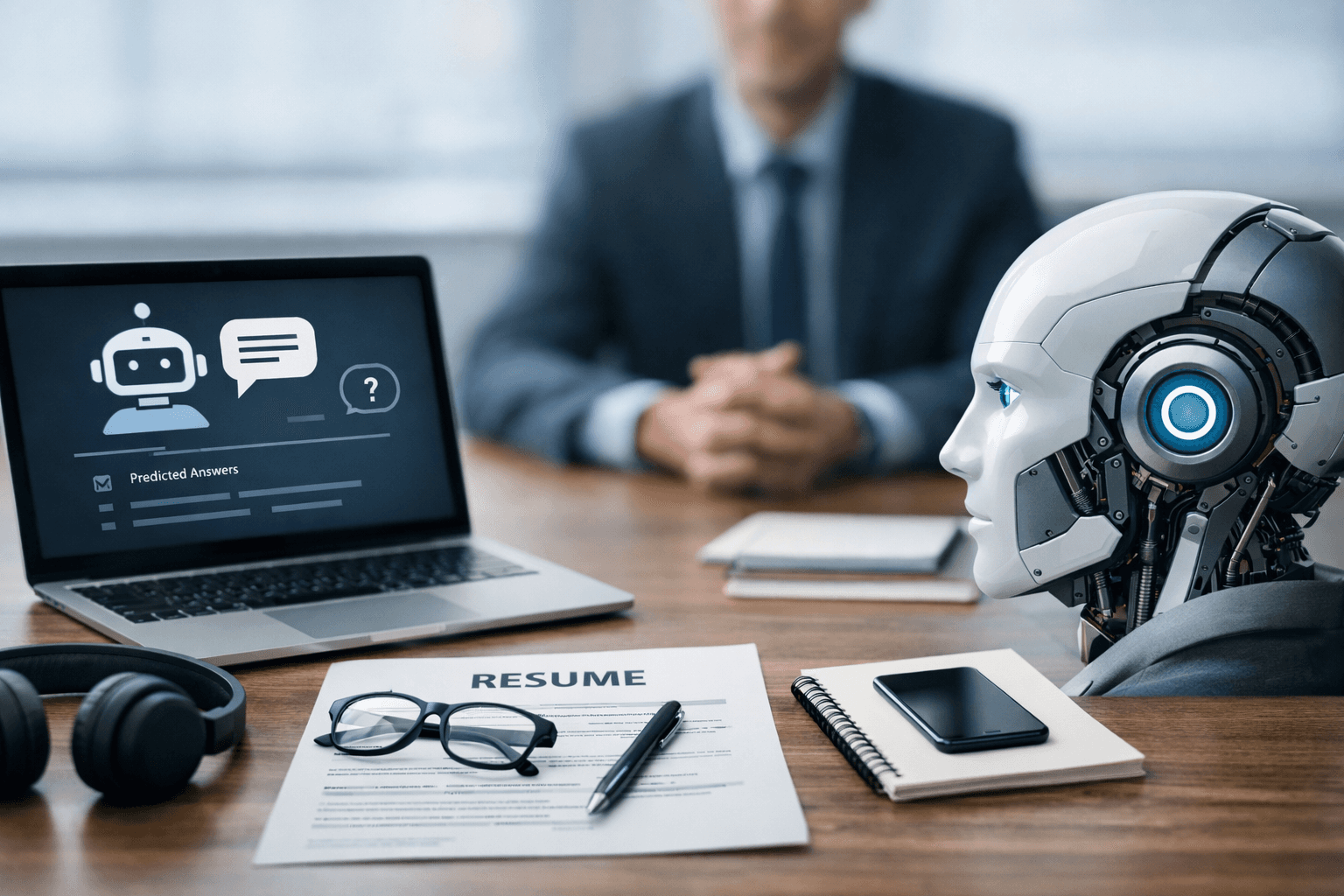
The Big Question: Can AI Really Predict Interview Questions?
It’s a question more job seekers are asking in 2026: Can AI actually predict what I’ll be asked in an interview? With hiring becoming more structured and competitive, candidates want every possible edge. Companies now rely heavily on standardized evaluation frameworks, competency matrices, and data-backed hiring decisions. That shift has made interviews feel less random and more patterned — which naturally raises the idea that patterns can be analyzed.
At the same time, candidates themselves are using AI more than ever. From resume feedback to mock interviews and company research, AI tools have become part of modern job preparation. If AI can analyze massive datasets, why couldn’t it anticipate interview questions too?
Here’s the honest answer: AI doesn’t “see the future.” It doesn’t know the exact sentence an interviewer will say. What it does extremely well is identify patterns based on job descriptions, previous interview reports, and industry norms.
So while AI can’t predict questions word-for-word, it can significantly narrow down the likely themes and formats you’ll face. In this guide, we’ll explore how AI makes predictions, how accurate it really is, where it falls short, and how to use it wisely.

How AI Predicts Interview Questions (What Data It Uses)
AI doesn’t guess interview questions randomly. It relies on data signals — and there are three major sources that shape its predictions.
1. Job Descriptions as Data Signals
The most powerful input is the job description itself. AI systems analyze patterns such as:
Repeated skills mentioned multiple times
Responsibility-focused keywords
Required tools or technical stacks
Leadership or collaboration signals
When certain phrases appear frequently, they act as indicators. For example, if a role highlights cross-functional collaboration three or more times, there’s a strong chance you’ll face behavioral questions about teamwork, stakeholder management, or conflict resolution.
If a posting emphasizes ownership and autonomy, expect questions about initiative and independent decision-making. AI identifies these recurring signals and maps them to common interview frameworks.
2. Industry-Specific Interview Patterns
Different industries follow predictable evaluation styles. Over time, patterns become clear:
Software engineering roles often focus on algorithms and system design.
Marketing positions typically emphasize campaign metrics, analytics, and ROI discussions.
Finance interviews frequently include valuation models and scenario analysis.
Because companies benchmark against competitors, these structures repeat across organizations.
3. Public Interview Reports
Platforms like Glassdoor, Reddit, and Blind contain thousands of candidate-reported experiences. AI models trained on aggregated discussions can detect common question types, formats, and evaluation trends.
According to general LinkedIn Talent Trends insights, structured interviews are becoming more common across industries, reinforcing predictable formats.
Ultimately, AI prediction is advanced pattern recognition — not magic, and certainly not mind reading.
What AI Can Predict Well (And Where It Struggles)
AI can be surprisingly accurate when interviews follow structured patterns. But it’s not equally strong in every situation. Understanding both sides helps you use it wisely instead of over-relying on it.
AI Interview Prediction Strengths vs Limitations
What AI Predicts Well | Where AI Struggles |
|---|---|
Common behavioral themes | Unexpected curveball questions |
Technical skill categories | Personal follow-ups |
Role-based case types | Culture-fit improvisation |
Leadership scenarios | Interviewer personality shifts |
AI performs best when interviews are competency-based and standardized. For example, if companies consistently assess teamwork, conflict resolution, or ownership, those behavioral themes are highly predictable. The same applies to technical categories — if a backend engineering role lists distributed systems and APIs, technical questioning will likely revolve around those domains.
Role-based case types are also predictable. Consulting interviews often include structured business cases, while product roles frequently test prioritization frameworks. Leadership scenarios appear regularly in mid-to-senior roles because they align with evaluation rubrics.
However, interviews are not always structured. AI struggles with spontaneous follow-up questions that depend on your previous answer. It can’t fully anticipate an interviewer’s personality, humor, or conversational style. Cultural fit discussions can shift dynamically based on the chemistry in the room.
In short, AI works best when interviews are structured and data-driven. It becomes less reliable when conversations become fluid and human-driven. Think of AI as a powerful assistant — not a crystal ball.
How Job Seekers Can Use AI to Prepare Smarter
AI becomes far more useful when you use it strategically. Instead of asking it random questions, treat it like a preparation partner. Here’s how to make it work in your favor.
Step 1 — Feed AI Better Inputs
The quality of output depends on the quality of input. To get meaningful predictions and practice material:
Upload your resume
Add the full job description
Include company information
Be specific about the role level and team
When AI understands your background and target role, it can identify stronger patterns and generate more relevant practice themes. Generic prompts produce generic preparation.
Step 2 — Practice Likely Question Themes
Instead of memorizing answers, organize your preparation into categories:
Technical questions
Behavioral questions
Situational or case-based questions
AI can help you cluster likely themes under each group. For example, technical practice might focus on tools listed in the job description, while behavioral themes may center around collaboration or ownership. This structured approach builds flexibility rather than scripted responses.
Step 3 — Improve Structure, Not Just Content
Strong answers are clear and organized. The STAR method — Situation, Task, Action, Result — is still widely used for behavioral responses. AI can help refine your structure, remove unnecessary details, and sharpen impact statements. Often, clarity matters more than length.
Step 4 — Simulate Real-Time Pressure
Preparation feels different when time pressure is involved. Unlike tools that only generate practice questions, Sensei AI works as a real-time interview copilot. It listens to live interviews, detects the interviewer’s question, and generates responses grounded in your uploaded resume and role details. This shifts AI from simple prediction to real-time assistance, helping candidates stay composed under pressure.
Try Sensei Ai for Free
Does Using AI in Interviews Cross an Ethical Line?

As AI tools become more common in job preparation, an important question naturally follows: is it ethical to use them?
In terms of preparation, most people would agree the answer is yes. Using AI to analyze job descriptions, practice responses, or refine your resume is not fundamentally different from working with a career coach or doing mock interviews with a friend. Preparation has always been encouraged. Candidates are expected to research the company, anticipate likely questions, and improve how they present their experience.
The more debated area is real-time assistance during interviews. Some companies may view it as innovative use of technology, while others may consider it outside their expectations. Policies can vary depending on the organization, industry, and interview format. That’s why it’s important to understand the context before deciding how to approach it.
There’s also the issue of authenticity. Preparation is fair. Misrepresentation is not. AI should help you articulate your real experience more clearly — not fabricate skills or exaggerate achievements.
Privacy is another factor to consider. Some AI tools are designed to be discreet and undetectable during virtual interviews, but candidates should still review company guidelines and understand how any tool they use operates.
Ultimately, responsible use comes down to judgment. AI can enhance preparation, but integrity remains your responsibility.
Beyond Prediction: Real-Time AI vs Pre-Interview AI
As AI becomes more integrated into job preparation, it helps to distinguish between two major categories of tools. They serve different purposes, and understanding that difference can shape how you prepare.
Category 1: Pre-Interview AI Tools
These tools focus on preparation before the interview begins. Common examples include:
Resume builders
Mock question generators
Company research assistants
They help candidates organize experience, anticipate likely themes, and refine messaging. For example, resume-focused AI tools can improve clarity and keyword alignment, while mock generators simulate commonly asked behavioral or technical questions.
Sensei AI also offers an AI Playground feature, where users can ask interview and workplace-related questions in a text-based format. This allows candidates to explore potential scenarios, clarify concepts, and refine responses before stepping into the actual interview environment.
Category 2: Real-Time Interview Copilot Tools
This category works differently. Instead of predicting what might be asked, these systems respond dynamically during the conversation itself. They are designed to support candidates under live conditions.
Sensei AI’s real-time system detects interviewer questions automatically in a hands-free manner and generates responses in under a second. The answers are customized using your uploaded resume, preferred tone, language, and structure settings. It also supports coding interviews through its Coding Copilot feature, helping candidates navigate technical challenges across platforms.
The key distinction is simple: pre-interview AI prepares you for possibilities, while real-time AI responds to reality as it unfolds.
Practice with Sensei AI
The Future: Will AI Make Interviews Obsolete?
With AI now influencing both sides of the hiring process, it’s natural to wonder whether traditional interviews will eventually disappear. Companies are already using AI-assisted hiring systems for resume screening, skill assessments, and even early-stage video analysis. Automated screening tools can filter large applicant pools faster than any human recruiter.
We’re also seeing the rise of human-AI hybrid interviews, where structured question banks, scoring rubrics, and analytics guide interviewer decisions. This makes interviews more standardized and data-driven than ever before.
At the same time, candidates are using AI to prepare — creating an interesting AI-versus-AI dynamic. Employers use algorithms to evaluate talent, while job seekers use algorithms to prepare for evaluation. The playing field is becoming more technological on both sides.
But will interviews vanish completely? Unlikely. Hiring still involves trust, communication, and cultural alignment — areas where human judgment matters deeply. What will change is how people prepare.
AI will continue reshaping preparation methods, making them more strategic and data-informed. Still, AI remains a tool. Candidates must bring judgment, adaptability, and authenticity into the room. Technology can enhance performance, but it cannot replace genuine communication.
Should You Rely on AI to Predict Interview Questions?

So, should you rely on AI to predict your interview questions?
The balanced answer is yes — but not blindly. AI can be an incredibly useful preparation partner when used thoughtfully. It helps you identify recurring themes, recognize skill gaps, and anticipate the types of conversations you’re likely to face. That alone can reduce anxiety and improve focus.
Used correctly, AI allows you to:
Identify patterns in job descriptions and industry expectations
Strengthen weak areas before they become interview obstacles
Practice clarity and structure in your responses
However, prediction is not the same as certainty. AI improves probability, not guarantees. It narrows the range of possibilities, but interviews still contain human unpredictability — follow-up questions, spontaneous discussions, and personality dynamics.
The smartest strategy combines preparation, adaptability, and the right tools. Let AI handle pattern recognition while you focus on judgment, storytelling, and authenticity. When technology and human skill work together, you’re far better positioned to succeed.
Try Sensei Ai Now!
FAQs
Is it okay to use AI for interview questions?
Yes, it is generally okay to use AI for preparation. Using AI to analyze job descriptions, practice responses, and refine your answers is similar to working with a career coach or doing mock interviews with a friend. The key is to use it responsibly — focus on improving clarity and structure rather than fabricating skills or achievements.
What is the 30 60 90 rule in interview?
The 30-60-90 rule is a framework to outline your plan for the first 30, 60, and 90 days in a new role. Candidates describe what they would focus on in each phase, showing that they understand priorities, can set goals, and can execute effectively. Interviewers often use it to evaluate strategic thinking and planning ability.
Can AI help me answer interview questions?
Yes, AI can help you formulate answers by identifying patterns from job descriptions, industry norms, and common interview questions. Tools like Sensei AI can also provide real-time assistance by generating responses based on your uploaded resume and role details, helping you structure clear and relevant answers.
How accurate is AI prediction?
AI prediction is not perfect; it cannot guarantee the exact questions you will face. Its strength lies in recognizing patterns and narrowing down likely themes, technical areas, and behavioral topics. Accuracy is higher in structured interviews and predictable industries but decreases when interviews are conversational or highly improvised.

Shin Yang
Shin Yang is a growth strategist at Sensei AI, focusing on SEO optimization, market expansion, and customer support. He uses his expertise in digital marketing to improve visibility and user engagement, helping job seekers make the most of Sensei AI's real-time interview assistance. His work ensures that candidates have a smoother experience navigating the job application process.
Learn More
Tutorial Series: Introducing Our New Chrome Extension Listener
Sensei AI vs Interviewing.io: Which Interview Tool Is Better for You in 2026?
Sensei AI vs Huru: Which AI Interview Tool Is Better in 2026?
Sensei AI vs Interview Warmup: Which Interview Practice Tool Is Better in 2026?
How Recruiters Detect AI Answers (and How to Stay Authentic)
Interview Copilot vs Traditional Interview Coaching: Which Is Better for Your Next Interview?
Best AI for Behavioral Interview Questions: 9 Tools to Practice Smarter in 2026
Google Interview Warmup Alternatives: 9 Best Tools to Practice for Interviews in 2026
How to Practice for an Interview by Yourself: A Step-by-Step Guide That Actually Works
Best AI Tools for Job Seekers in 2026
Sensei AI
hi@senseicopilot.com