

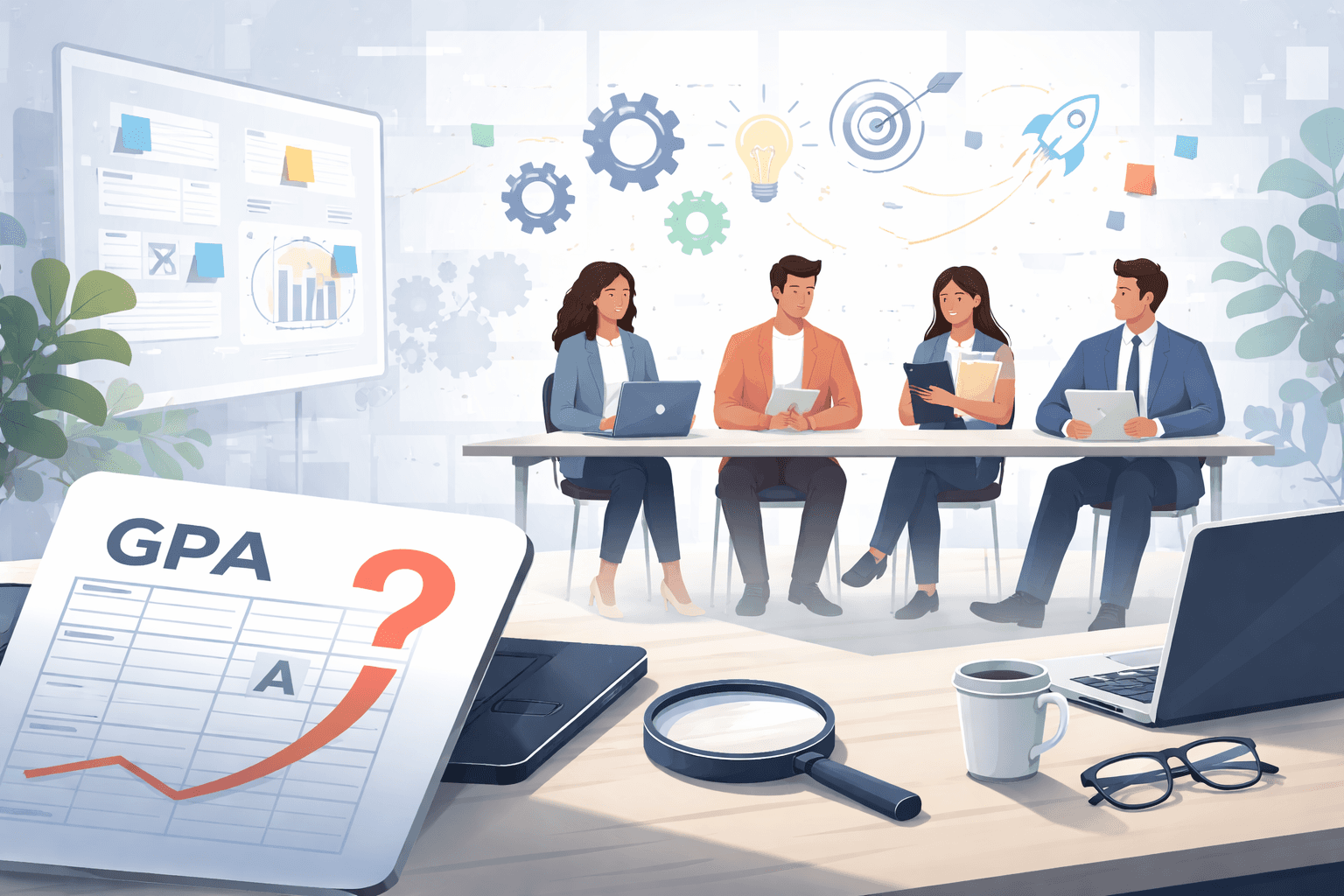
The Shift: Why GPA Is No Longer the Ultimate Signal of Talent
For decades, GPA (Grade Point Average) was one of the most commonly used signals in hiring. Recruiters often viewed it as a simple way to measure academic performance, work ethic, and intellectual ability. A strong GPA suggested that a candidate was disciplined, capable of learning complex material, and able to perform consistently under pressure. Because of this, many companies—especially large corporations and consulting firms—historically applied GPA cutoffs when screening applicants. Candidates below a certain threshold might not even receive an interview opportunity.
However, the modern job market looks very different from the one where GPA first became a hiring shortcut. Rapid technological progress, widespread AI adoption, and constantly evolving business models have changed the nature of work. Skills that were valuable five years ago may already be outdated today. As a result, many roles now demand continuous learning and adaptation, rather than relying solely on knowledge gained during university.
Because of this shift, employers are increasingly paying attention to something called learning velocity. Instead of focusing only on past academic performance, companies want people who can learn quickly, adapt to new tools and ideas, and apply knowledge effectively in unfamiliar situations.
Understanding learning velocity helps explain why some candidates thrive in fast-changing industries—even when their GPA isn’t the highest on paper.
What “Learning Velocity” Actually Means
Learning velocity refers to how quickly and effectively someone can acquire new knowledge, understand it, and apply it in real situations. It is not just about being smart or studying hard. Instead, it reflects how efficiently a person can process unfamiliar information, connect it with what they already know, and turn it into useful action. In fast-moving industries where tools, technologies, and expectations change frequently, the ability to learn quickly often becomes more valuable than simply having a large amount of existing knowledge.
Three Core Elements of Learning Velocity
Speed of Understanding
This refers to how quickly someone can grasp new ideas, systems, or frameworks. For example, when starting a new project or learning a new platform, people with strong learning velocity can understand key concepts rapidly without needing long adjustment periods.
Adaptability
Adaptability means being comfortable when information changes or when situations become uncertain. Instead of struggling when a process changes, high-velocity learners adjust their approach and continue moving forward.
Application
The final component is the ability to use newly learned information in practical situations. True learning velocity is demonstrated when someone can take a concept and apply it to solve real problems, not just explain the theory behind it.
In everyday work environments, learning velocity appears in many ways. Someone might quickly learn a new analytics tool, adapt to a different team structure, or solve a problem they have never encountered before. These situations require both fast understanding and practical application.
In modern hiring environments, employers increasingly look for signals of this ability during interviews. Tools such as Sensei AI can help candidates prepare for these moments by detecting interview questions in real time and generating structured responses grounded in the user’s resume and background, helping them practice explaining how they learn and adapt to new challenges.
Try Sensei AI for Free
Why Companies Care About Learning Velocity More Than GPA
For many years, GPA served as a convenient shortcut for evaluating candidates. It reflects how well someone performed academically during a specific period of time, usually within structured educational systems. While that information can show discipline and subject mastery, it does not necessarily predict how well a person will adapt to new challenges later in their career. A candidate may have earned excellent grades in a stable academic environment but still struggle when confronted with unfamiliar tools, shifting priorities, or rapidly evolving industries.
Today, many industries change far too quickly for static knowledge to remain valuable for long. Fields such as technology, marketing, data science, and finance constantly introduce new platforms, frameworks, and analytical methods. Professionals working in these sectors often need to learn new systems every few months, not every few years. As a result, companies are increasingly looking for people who can absorb new information quickly and adapt their thinking as circumstances evolve.
This trend is supported by workforce research. According to the LinkedIn Workplace Learning Report (2024–2025), learning agility and adaptability rank among the most important skills organizations expect employees to develop in the coming years. Employers recognize that the pace of innovation makes continuous learning essential.
The difference between GPA and learning velocity ultimately comes down to static knowledge versus dynamic learning ability. GPA reflects what someone already knows, while learning velocity reflects how quickly they can grow beyond their current knowledge.
To understand the difference more clearly, compare what GPA and learning velocity actually measure.
GPA vs Learning Velocity
Factor | GPA | Learning Velocity |
|---|---|---|
Academic performance vs skill acquisition | Measures academic performance in school | Reflects the ability to acquire new skills quickly |
Measures past knowledge vs measures future potential | Indicates how well someone mastered past coursework | Shows how quickly someone can learn in the future |
Works best in stable fields vs valuable in fast-changing fields | More relevant in structured or predictable environments | Especially valuable in industries that evolve rapidly |
Often individual study vs collaborative learning and experimentation | Typically based on individual academic work | Often developed through experimentation, teamwork, and real-world problem solving |
Ultimately, companies want employees who can grow alongside the role itself. Instead of focusing only on what a candidate already knows, employers increasingly prioritize people who can continuously learn, adapt, and expand their capabilities as the workplace evolves.
Signs That Someone Has High Learning Velocity
Unlike GPA, which is measured through grades and transcripts, learning velocity is usually visible through behavior. Employers and managers often recognize it by observing how people approach unfamiliar situations. When someone encounters a new problem, do they become stuck, or do they explore solutions quickly? Do they wait for instructions, or do they actively search for answers? These behaviors provide stronger signals of learning ability than academic records alone.
Five Indicators of High Learning Velocity
Asking Better Questions
People who learn quickly tend to ask clear and thoughtful questions. Instead of staying confused, they clarify assumptions, confirm details, and make sure they understand the problem before attempting a solution.
Pattern Recognition
High learning velocity often shows up through recognizing similarities between different problems. Someone may notice that a challenge resembles something they encountered before, allowing them to apply previous lessons to a new context.
Fast Feedback Loops
Another important indicator is the habit of testing ideas quickly and adjusting based on results. Rather than waiting for perfect answers, high-velocity learners experiment, observe outcomes, and refine their approach.
Self-Directed Learning
People with strong learning velocity rarely wait for formal training. They often seek out resources themselves, such as online tutorials, documentation, books, or short courses to close knowledge gaps.
Comfort with Uncertainty
Finally, high learning velocity requires staying productive even when the answer is unclear. Instead of avoiding ambiguity, these individuals move forward, gather information, and adapt as they learn more.
Because these traits are behavioral, interviewers frequently design questions to reveal them. Behavioral questions and problem-solving scenarios allow employers to observe how candidates think, how they approach unfamiliar challenges, and how they describe their learning process.
Candidates preparing for interviews often practice explaining how they handled new or unexpected situations in past roles. Tools such as Sensei AI can assist during interviews by detecting the interviewer’s question and generating personalized response suggestions grounded in the user’s resume, helping candidates clearly articulate their problem-solving experiences and how they learned from them.
Practice with Sensei AI
How Employers Actually Evaluate Learning Velocity

Most employers will never ask a candidate directly, “Do you have high learning velocity?” The concept is important in hiring, but it usually appears indirectly. Instead of asking about it explicitly, interviewers design questions and tasks that reveal how a candidate learns, adapts, and thinks through unfamiliar situations. By observing how someone approaches a problem, recruiters can often identify learning velocity more effectively than by simply reviewing a transcript or résumé.
Common Interview Signals Employers Look For
Case or Scenario Questions
Interviewers often present hypothetical problems or business situations the candidate has never encountered before. The goal is not necessarily to find the perfect answer, but to observe how the candidate approaches an unfamiliar challenge, organizes their thoughts, and explores possible solutions.
Behavioral Questions
Behavioral questions are another common method. Employers frequently ask prompts such as “Tell me about a time you had to learn something quickly.” These questions reveal how candidates handled past situations where rapid learning and adaptation were required.
Technical Problem Solving
In technical interviews, especially in fields like engineering or data analysis, interviewers pay close attention to the thought process behind the solution. Even if the final answer is imperfect, a candidate who explains their reasoning clearly and adjusts their approach based on new information demonstrates strong learning ability.
Learning History
Employers also examine how candidates describe their personal learning journey. This may include switching industries, acquiring new technical skills, or teaching themselves tools outside of formal education. These stories help recruiters understand how quickly someone can grow when faced with new demands.
Ultimately, interviewers are usually more interested in how candidates think than what they have memorized. A thoughtful explanation of the reasoning process often matters more than arriving at the perfect solution immediately.
Because of this, storytelling and structured responses become extremely valuable during interviews. When candidates can clearly explain how they approached a challenge, what they learned from it, and how they applied that lesson later, they provide strong evidence of learning velocity.
Practical Ways to Increase Your Learning Velocity
A common misconception is that learning velocity is something people are simply born with. In reality, it behaves much more like a trainable skill. Just as athletes improve performance through structured practice, professionals can increase their learning speed by developing better learning habits. With the right strategies, anyone can become more efficient at absorbing new information, adapting to unfamiliar situations, and applying knowledge in practical ways.
Four Ways to Train Your Learning Velocity
Deliberate Practice
One effective strategy is focusing on difficult tasks instead of repeating comfortable ones. When people consistently challenge themselves with harder problems, they force their brain to build new connections. This accelerates learning and prevents stagnation.
Rapid Experimentation
High-velocity learners rarely wait for perfect conditions. Instead, they test ideas quickly, observe the results, and refine their approach. Rapid experimentation shortens the learning cycle and allows individuals to improve through continuous adjustment.
Reflection Loops
Another important habit is structured reflection. After completing a task or project, strong learners take time to ask: What worked? What didn’t? What would I do differently next time? These reflection loops transform everyday experiences into powerful learning opportunities.
Cross-Disciplinary Learning
Learning across multiple fields can also improve learning velocity. When people explore topics outside their primary expertise—such as combining technical knowledge with communication or design—they develop stronger pattern recognition, making it easier to solve unfamiliar problems.
Documenting learning progress can further reinforce this process. Keeping notes, writing short summaries after projects, or maintaining a learning journal helps people track insights and recognize patterns in their own development over time.
Some candidates also use AI tools to support reflection and interview preparation. For example, Sensei AI’s AI Playground allows users to ask interview and career-related questions in a conversational format, which can help them analyze past experiences and practice explaining how they learned new skills in professional settings.
Try Sensei AI Now!
Why Learning Velocity Will Matter Even More in the AI Era
Artificial intelligence is accelerating the speed of change across nearly every industry. New tools, platforms, and workflows are appearing much faster than before, reshaping how teams operate and how decisions are made. Tasks that once required hours of manual work can now be automated or augmented by AI systems. While this creates new opportunities, it also means professionals must continuously learn new tools, adapt to new processes, and rethink how they approach problem-solving.
Because of this rapid transformation, many jobs are evolving faster than traditional education systems can keep up. University programs are often designed years in advance, while the tools used in modern workplaces may change several times within that same period. As a result, graduates entering the workforce may find that some of what they learned is already outdated. What matters more is how quickly they can update their knowledge once they start working.
Research supports this shift. According to the World Economic Forum’s Future of Jobs Report, nearly 50% of core workplace skills are expected to change within the next five years as technology and automation continue to reshape the global economy. This highlights how essential continuous learning has become for long-term career growth.
In this environment, learning velocity becomes a powerful competitive advantage. Professionals who can absorb new information quickly, experiment with emerging tools, and adapt their thinking will remain valuable even as industries evolve.
Understanding and developing learning velocity is therefore not just helpful for landing a job today—it is a skill that will shape career success in the years ahead.
Your GPA Is a Snapshot, Your Learning Velocity Is the Trajectory
A GPA is ultimately a snapshot of past performance. It reflects how well someone performed in a structured academic environment at a specific point in time. Learning velocity, on the other hand, represents future potential—how quickly a person can absorb new knowledge, adapt to change, and apply what they learn in real-world situations. In modern workplaces where industries evolve constantly, this forward-looking ability often becomes more valuable than historical academic metrics.
This perspective is especially encouraging for people who feel their GPA does not fully represent their capabilities. An average GPA does not define someone’s capacity to grow. Many successful professionals built their careers not by having perfect grades, but by continuously learning, experimenting, and improving their skills over time.
Today, employers increasingly look for candidates who demonstrate curiosity, adaptability, and the ability to acquire new skills quickly. These qualities signal that someone can keep up with changing technologies, shifting business priorities, and evolving job responsibilities.
In a world where knowledge becomes outdated faster than ever, the most valuable advantage may not be what you already know—but how quickly you can learn the next thing.

Shin Yang
Shin Yang is a growth strategist at Sensei AI, focusing on SEO optimization, market expansion, and customer support. He uses his expertise in digital marketing to improve visibility and user engagement, helping job seekers make the most of Sensei AI's real-time interview assistance. His work ensures that candidates have a smoother experience navigating the job application process.
Learn More
Tutorial Series: Introducing Our New Chrome Extension Listener
Sensei AI vs Interviewing.io: Which Interview Tool Is Better for You in 2026?
Sensei AI vs Huru: Which AI Interview Tool Is Better in 2026?
Sensei AI vs Interview Warmup: Which Interview Practice Tool Is Better in 2026?
How Recruiters Detect AI Answers (and How to Stay Authentic)
Interview Copilot vs Traditional Interview Coaching: Which Is Better for Your Next Interview?
Best AI for Behavioral Interview Questions: 9 Tools to Practice Smarter in 2026
Google Interview Warmup Alternatives: 9 Best Tools to Practice for Interviews in 2026
How to Practice for an Interview by Yourself: A Step-by-Step Guide That Actually Works
Best AI Tools for Job Seekers in 2026
Sensei AI
hi@senseicopilot.com