

The Big Question: What Does “AI-Proof” Really Mean in 2026?
If you’ve opened LinkedIn or read the news lately, you’ve probably seen the same headlines: AI is replacing jobs. Automation is accelerating. Generative tools are writing code, designing graphics, even drafting legal documents. It’s no surprise that many professionals are quietly asking themselves, “Will my role still exist in a few years?”
But the reality is more nuanced than the headlines suggest.
AI is transforming work — yes. But transformation doesn’t automatically mean elimination. In most industries, we’re not seeing entire professions disappear overnight. Instead, we’re seeing job descriptions evolve, skill requirements shift, and certain tasks become automated while others become more valuable.
The Difference Between “Automated” and “Augmented”
According to the 2023 World Economic Forum Future of Jobs Report, AI and automation are projected to create more roles than they eliminate over the long term. Many positions will be redesigned rather than removed. Similarly, research from the McKinsey Global Institute (2023 analysis) suggests that while up to 30 percent of tasks in many jobs can be automated, full job replacement remains relatively rare.
This distinction matters. Automation replaces repetitive tasks. Augmentation enhances human capability. Most modern careers fall into the second category.
In other words, AI is often becoming a tool that supports professionals — not a system that replaces them entirely.
The Three Signals of an AI-Resistant Career
When analyzing hiring data and labor projections, three common characteristics show up repeatedly in resilient roles:
Requires human judgment and complex decision-making
Involves high emotional intelligence, trust, or ethical responsibility
Depends on real-world physical presence or nuanced collaboration
Careers that combine these elements are harder to automate because they rely on context, empathy, adaptability, and real-time judgment.
Instead of asking “Which jobs won’t change?”, the better question is: “Which jobs become more valuable because of AI?”

Fastest-Growing AI-Resistant Career Clusters (Based on Hiring Data)
This section draws on recent labor market insights from LinkedIn’s Jobs on the Rise, the U.S. Bureau of Labor Statistics (BLS), and Indeed Hiring Lab reports. Across these sources, a consistent pattern emerges: while some routine roles are slowing down, several career clusters are expanding rapidly — especially those that either build AI systems, rely on deep human trust, or require hands-on technical expertise.
AI + Tech Builders (Not Replaced, But Empowered)
Some of the most resilient careers are not avoiding AI — they’re building and managing it. Roles such as:
Machine Learning Engineer
AI Product Manager
Cybersecurity Analyst
Data Engineer
These professionals design algorithms, align AI tools with business strategy, secure digital infrastructure, and maintain data pipelines. As AI adoption grows, so does the demand for people who understand how to implement and govern it responsibly.
Below is a snapshot of projected growth trends based on recent BLS data and LinkedIn hiring insights:
Role | Projected Growth | Why It’s Resilient |
|---|---|---|
Cybersecurity Analyst | 30%+ | Security threats increase with AI systems |
Data Scientist | 20%+ | AI needs clean, structured, and well-managed data |
AI Product Manager | Rapid growth on LinkedIn | Human decision-making combined with technical alignment |
These roles combine technical depth with strategic oversight, making them difficult to automate fully.
Healthcare & Human-Centered Professions
Another cluster showing strong growth includes:
Nurse Practitioner
Mental Health Counselor
Occupational Therapist
These professions depend heavily on emotional intelligence, ethical responsibility, and in-person care. While AI can assist with diagnostics or documentation, it cannot replace empathy, patient trust, or complex human judgment in sensitive situations. Healthcare continues to expand globally due to aging populations and increased mental health awareness, reinforcing long-term demand.
Skilled Trades & Physical Expertise
Skilled trades are often overlooked in AI discussions, yet they remain highly resilient. Examples include:
Electricians
Wind turbine technicians
Advanced manufacturing specialists
These jobs operate in unpredictable physical environments where automation is costly and technically complex. Installing wiring in an older building or repairing renewable energy systems requires adaptability and hands-on precision that machines struggle to replicate.
As more professionals pivot toward these high-growth paths, competition for top roles is increasing. Tools like Sensei AI can help candidates prepare more effectively by providing real-time interview assistance based on their resume and role details — particularly useful in technical or rapidly evolving industries.
The next step is understanding the specific skills that make professionals stand out within these growing fields.
Try Sensei AI for Free
The Skills That Actually Make You AI-Proof
It’s less about job titles and more about skill stacks. In 2026, being “AI-proof” doesn’t mean choosing a magical profession that automation can’t touch. It means combining capabilities that technology can support — but not fully replace. Employers are increasingly hiring for blended strengths rather than narrow expertise.
Technical Fluency (Even for Non-Tech Roles)
You don’t need to become a software engineer to stay competitive, but you do need a baseline understanding of how technology works. Across industries, employers are prioritizing:
Basic data literacy
Understanding of AI workflows and automation tools
Prompt engineering fundamentals
Data literacy means knowing how to interpret dashboards, question metrics, and make decisions based on evidence. Understanding AI workflows helps you collaborate with technical teams more effectively. Even prompt engineering — the ability to communicate clearly with AI tools — is becoming a practical workplace skill rather than a niche trick.
Technical fluency signals adaptability, which hiring managers consistently value.
Human Skills AI Struggles With
While AI excels at speed and pattern recognition, it still struggles with deeply human judgment. The following capabilities remain highly defensible:
Negotiation
Leadership under ambiguity
Cross-cultural communication
Creative problem framing
These skills require context awareness, emotional intelligence, and ethical reasoning. They are shaped by lived experience, not just data inputs.
Human Skill | Why AI Struggles | Example in Workplace |
|---|---|---|
Conflict mediation | Requires emotional nuance and trust | Managing team disputes |
Strategic trade-offs | Needs long-term context and judgment | Budget allocation decisions |
The more your work involves these dimensions, the more resilient your career becomes.
Meta-Skills That Multiply Everything
Beyond technical and interpersonal strengths, there’s another layer:
Learning agility
Systems thinking
Adaptability
Learning agility allows you to reskill quickly as industries shift. Systems thinking helps you see connections across teams and processes. Adaptability ensures you remain valuable even as tools evolve.
If you’re unsure how to articulate these skills in interviews, using a tool like Sensei AI’s AI Playground — a text-based AI focused on interview and workplace questions — can help you practice framing your experiences clearly and confidently.
Ultimately, AI-proof careers are built by people who combine technical awareness with distinctly human depth.
Practice with Sensei AI
Careers That Look Safe (But May Shrink)
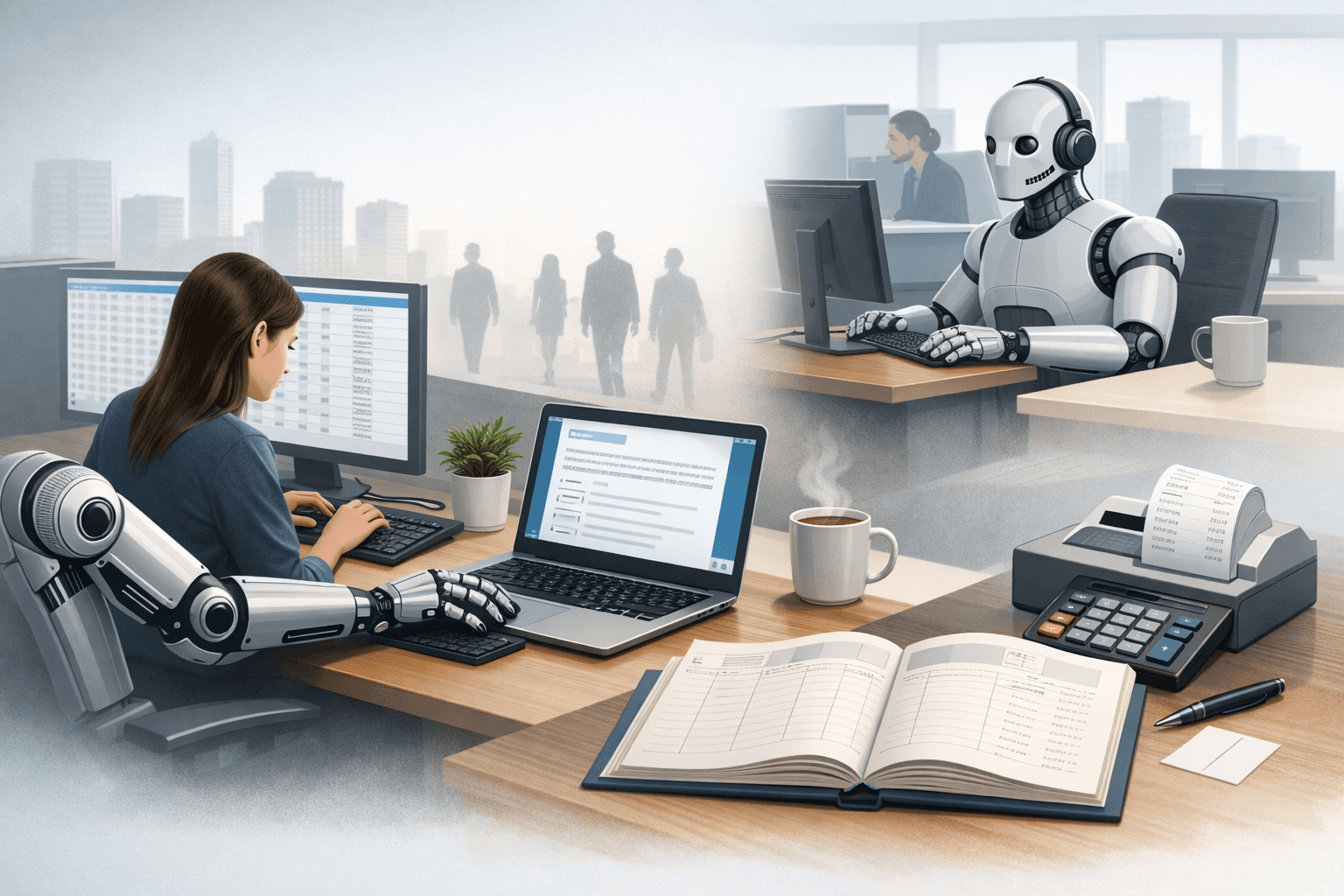
Not every stable-looking role is future-proof. Some positions appear secure today but are increasingly vulnerable to automation at the task level. This doesn’t mean these careers will disappear overnight — but growth may slow, and responsibilities may narrow.
Examples include:
Basic data entry
Routine content generation
Tier-1 customer support
Simple bookkeeping
These roles often rely on structured, repetitive workflows. According to McKinsey’s 2023 automation task analysis, jobs composed primarily of predictable, rules-based activities are the easiest to automate. Similarly, a 2023 Goldman Sachs AI impact study estimated that a significant percentage of administrative and clerical tasks could be partially automated using generative AI tools.
The key word here is partially.
Automation typically handles standardized processes faster and cheaper. When tasks can be completed using clear rules and historical patterns, AI systems perform well. That’s why entry-level documentation, templated reports, and scripted support interactions are increasingly assisted — or replaced — by software.
The “Task vs. Job” Trap
It’s important not to confuse task automation with full job elimination. AI usually replaces specific tasks first, not entire professions.
For example, bookkeeping software can categorize transactions automatically. But financial oversight, compliance decisions, and strategic planning still require human judgment. Customer support chatbots can answer common questions, but escalations and sensitive cases still demand empathy and problem-solving.
The takeaway isn’t fear — it’s awareness. If your current role leans heavily on repetitive tasks, the smartest move isn’t panic. It’s expansion. Add analytical responsibility. Develop client-facing skills. Learn tools that move you from executor to decision-maker.
Careers shrink when skills stagnate. They grow when professionals evolve alongside technology.
How to Position Yourself for an AI-Resilient Career
Knowing which careers are growing is helpful. Acting on that information is what actually changes your trajectory. Positioning yourself for an AI-resilient future doesn’t require a dramatic career reset — it requires strategic upgrades.
Step 1 — Audit Your Current Role
Start by breaking your job into tasks.
Ask yourself:
Which tasks are repetitive and rule-based?
Which responsibilities require judgment, context, or decision-making?
If most of your day is spent on predictable processes, that’s a signal. If you regularly make decisions, manage stakeholders, or solve ambiguous problems, you’re already building resilience.
This audit isn’t about labeling your job as “safe” or “unsafe.” It’s about identifying where you can expand. Can you take ownership of analysis instead of just execution? Can you move closer to strategy instead of operations? Small shifts compound over time.
Step 2 — Add One High-Leverage Skill
You don’t need five new certifications. One well-chosen skill can significantly increase your market value.
Examples include:
A cybersecurity certification in a tech-adjacent role
An AI literacy or data fundamentals course
A project management credential
The key is leverage. Choose a skill that complements what you already do and pushes you toward decision-making, oversight, or cross-functional collaboration. Employers increasingly favor professionals who combine domain expertise with digital fluency.
Step 3 — Prepare for Smarter Interviews
Hiring processes are evolving alongside technology. Companies are digging deeper before making offers.
Expect:
More behavioral depth
More case-based scenarios
More technical screening
Interviewers want evidence of adaptability, systems thinking, and real-world impact — not just keyword matches on a résumé.
In competitive roles, real-time interview support tools like Sensei AI can help candidates respond confidently to technical and behavioral questions by referencing their uploaded resume and job details. It works hands-free during interviews and supports multiple languages, which is helpful for global applicants.
For candidates transitioning careers, simple resume drafting tools like Sensei AI’s AI Editor can help organize experience into a clearer format before interviews.
Positioning yourself well means combining skill development with strong communication. The professionals who thrive in 2026 won’t just have relevant capabilities — they’ll know how to present them effectively.
Try Sensei AI Now!
The Real Future: AI-Proof Isn’t About Avoiding AI

By now, one thing should be clear: the safest careers in 2026 are not the ones hiding from AI. They’re the ones learning how to work alongside it.
Trying to avoid technology is a short-term strategy. Collaboration is a long-term advantage. The professionals seeing the strongest career growth today are those who understand how AI tools function, where their limits are, and how to combine them with human insight. They don’t compete with automation — they direct it.
Human Judgment + AI Speed = Competitive Advantage
AI amplifies skilled professionals. It accelerates research, drafts first versions, analyzes large datasets, and surfaces patterns. But it still relies on human oversight to interpret results, make ethical decisions, and set direction.
When you combine:
Human judgment
Context awareness
Strategic thinking
with:
AI speed
Automation efficiency
Data-driven insights
you create a powerful professional edge.
This is the real definition of “AI-proof.” Not immunity from change, but relevance within it.
Looking ahead, the smartest move isn’t guessing which single job will survive untouched. It’s tracking hiring data, noticing which skills are trending upward, and investing in capabilities that travel across industries. Stay curious. Stay adaptable. Keep refining how you communicate your value.
Hiring data shows growth in technology builders, healthcare professionals, and skilled trades. Skill trends highlight adaptability, systems thinking, and human-centered leadership. Interview processes are becoming more rigorous and more nuanced.
Those who thrive in 2026 will be the ones who read the signals, evolve deliberately, and prepare intentionally. AI is reshaping the job market — but for prepared professionals, that reshaping creates opportunity, not risk.
FAQs
What are the AI-proof jobs for 2026?
AI-proof jobs in 2026 are roles that rely heavily on human judgment, emotional intelligence, strategic thinking, and complex decision-making. Examples include healthcare professionals, senior engineers, cybersecurity analysts, product managers, skilled trades, educators, and mental health specialists.
These roles involve problem-solving in unpredictable environments, interpersonal communication, and accountability — areas where AI still functions as a support tool rather than a replacement.
What jobs will be AI-proof in the future?
In the future, the most resilient jobs will not be “AI-free” — they will be AI-collaborative. Careers that combine domain expertise with the ability to use AI tools effectively will remain strong.
Fields like advanced software engineering, AI system oversight, regulatory compliance, healthcare, infrastructure, and creative direction are likely to evolve — but not disappear. Professionals who adapt and integrate AI into their workflow will have a competitive advantage.
Which job is best for the future in 2026?
There is no single “best” job for 2026. The strongest future careers share three traits:
High problem-solving complexity
Human interaction and communication
Continuous learning and adaptability
Roles in AI engineering, cybersecurity, healthcare, renewable energy, and product strategy currently show strong growth potential. However, long-term success depends more on skill adaptability than on job title alone.
What industries will AI completely take over by 2026?
By 2026, AI is unlikely to completely take over any major industry. Instead, it will automate specific tasks within industries.
Routine data entry, basic content drafting, simple bookkeeping, and tier-1 customer support tasks are already being heavily automated. However, full industries still require oversight, regulation, strategic planning, and human accountability.
The more accurate question isn’t which industries AI will replace — it’s which professionals will learn to work with it.

Shin Yang
Shin Yang est un stratégiste de croissance chez Sensei AI, axé sur l'optimisation SEO, l'expansion du marché et le support client. Il utilise son expertise en marketing numérique pour améliorer la visibilité et l'engagement des utilisateurs, aidant les chercheurs d'emploi à tirer le meilleur parti de l'assistance en temps réel aux entretiens de Sensei AI. Son travail garantit que les candidats ont une expérience plus fluide lors de la navigation dans le processus de candidature.
En savoir plus
Série de tutoriels : Présentation de notre nouvelle extension Chrome Listener
Sensei AI vs Interviewing.io: Which Interview Tool Is Better for You in 2026?
Sensei AI vs Huru: Which AI Interview Tool Is Better in 2026?
Sensei AI vs Interview Warmup: Which Interview Practice Tool Is Better in 2026?
How Recruiters Detect AI Answers (and How to Stay Authentic)
Interview Copilot vs Traditional Interview Coaching: Which Is Better for Your Next Interview?
Best AI for Behavioral Interview Questions: 9 Tools to Practice Smarter in 2026
Google Interview Warmup Alternatives: 9 Best Tools to Practice for Interviews in 2026
How to Practice for an Interview by Yourself: A Step-by-Step Guide That Actually Works
Best AI Tools for Job Seekers in 2026
Sensei AI
hi@senseicopilot.com