
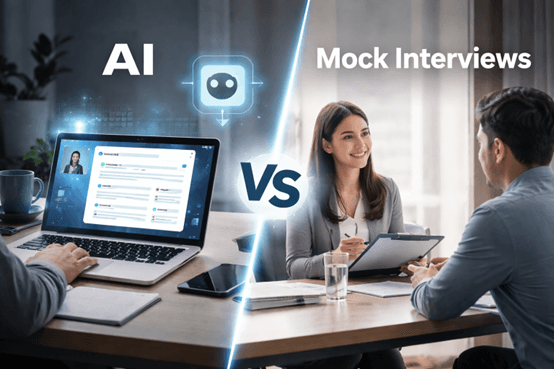
The New Interview Prep Dilemma
Job seekers today are no longer struggling with a lack of preparation resources—instead, they are overwhelmed by too many options. From AI-powered tools to traditional coaching methods, the real challenge has shifted from finding help to choosing the right kind of help. This creates a new kind of confusion: what actually works when it comes to getting hired?
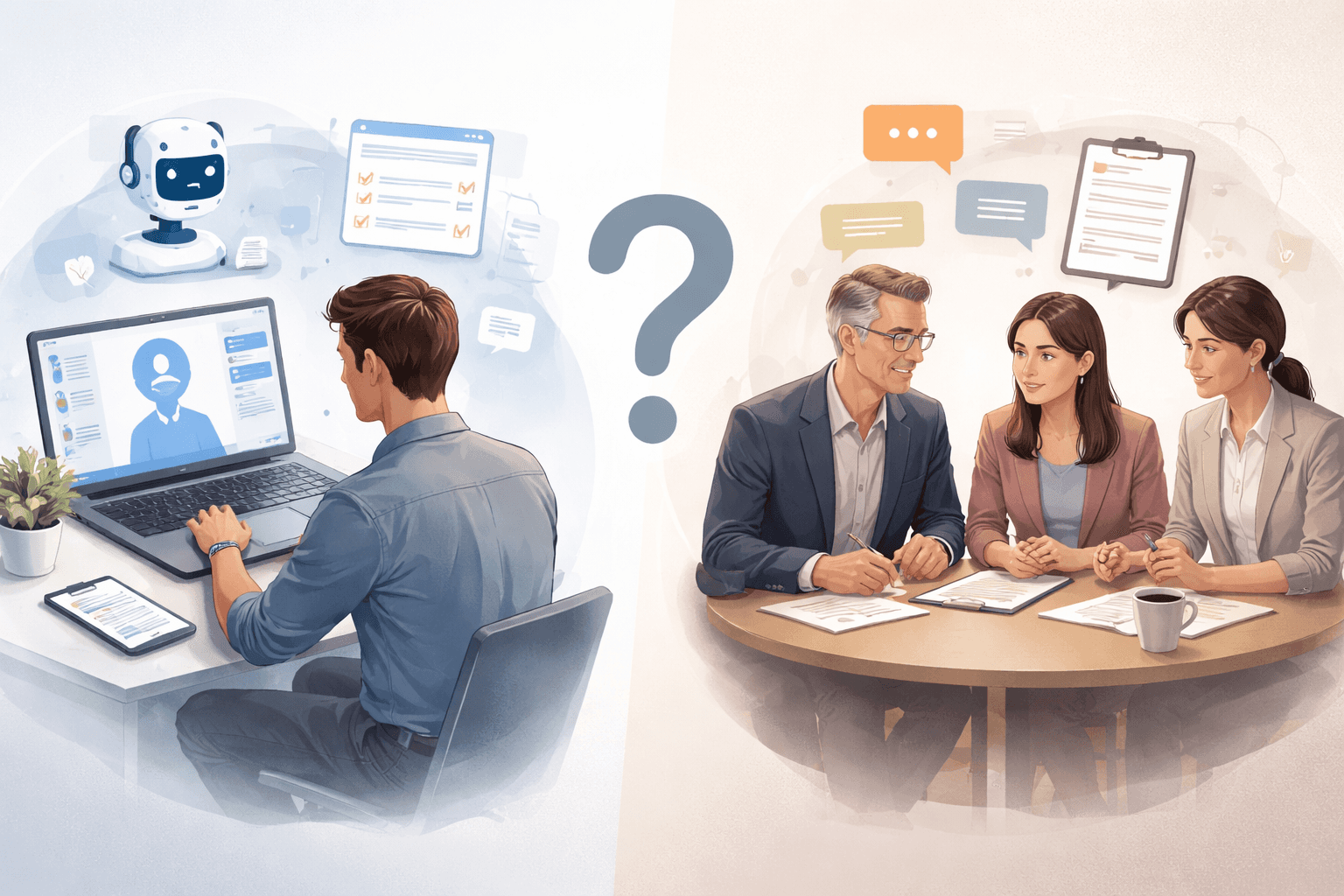
At the center of this shift are two dominant approaches. On one side, there are AI-powered interview tools that promise speed, personalization, and real-time support. On the other, traditional mock interviews—whether with friends, mentors, or professional coaches—offer human feedback, realistic pressure, and communication practice. Both claim to improve your chances, but they do so in very different ways.
So the real question becomes: which one actually leads to job offers, not just better practice sessions?
This isn’t a “winner takes all” comparison. The goal here is not to declare one method superior, but to help you understand when and how to use each effectively based on your situation.
Hiring itself has also evolved. With AI screening, shorter hiring cycles, and remote interviews becoming the norm, preparation strategies need to adapt as well. To make the right choice, it’s important to understand how these approaches compare in real scenarios.
What AI Interview Tools Actually Do
AI interview tools are designed to support candidates before and during interviews by helping them generate, structure, and refine answers. In simple terms, they act as assistants that use data—like your resume, job description, and common interview patterns—to guide your responses more effectively.
These tools offer several key capabilities. First, they can provide real-time answer suggestions, helping you respond quickly when faced with unexpected questions. Second, they use resume-based personalization, meaning the answers are tailored to your actual experience rather than generic templates. Third, they deliver fast response generation, often within seconds, which is especially useful in high-pressure situations.
It’s also important to distinguish between two types of AI tools. Some are practice tools, which help you prepare by generating sample questions and answers ahead of time. Others function as real-time interview copilots, supporting you during the interview itself by detecting questions and assisting with structured responses.
Where AI Really Shines
Speed and scalability, allowing you to practice or get help anytime
Always available, with no scheduling required
Reduces “blank mind” moments by offering immediate guidance
In real scenarios, AI tools are particularly useful for technical interviews, where structured answers matter, behavioral questions that require clarity, and multilingual candidates who may need support expressing ideas fluently.
Tools like Sensei AI provide real-time assistance by listening to interview questions and generating tailored answers based on your resume. However, they work best as a support layer—not a replacement for genuine preparation and understanding.
But AI isn’t the full picture.
Try Sensei Ai for Free
What Mock Interviews Still Do Better
Mock interviews are practice sessions that simulate real interview conditions with another person or through self-review. Unlike AI tools, they focus less on generating answers and more on how you deliver them. The goal is to recreate the pressure, flow, and unpredictability of an actual interview as closely as possible.
There are several common formats. Peer-to-peer mock interviews involve practicing with friends or colleagues, often in an informal setting. Professional coaching offers more structured feedback from experienced interviewers who understand hiring expectations. Recorded self-practice, where you answer questions on camera and review your performance, is another accessible option that helps identify personal habits and areas for improvement.
What Humans Catch That AI Often Misses
Body language, including eye contact, posture, and gestures
Tone and confidence, which influence how your answers are perceived
Storytelling quality, especially how clearly and engagingly you communicate experiences
Beyond technique, mock interviews provide strong emotional and psychological benefits. They help build real confidence by exposing you to pressure in a controlled environment, making the actual interview feel more familiar and manageable.
In practice, mock interviews are especially valuable for behavioral interviews using frameworks like STAR, as well as leadership or communication-heavy roles where delivery matters as much as content.
However, they come with limitations. Scheduling can be difficult, and the quality of feedback often depends on the experience of the person you practice with.
So now we have two powerful but very different tools.
Real-World Pressure and Feedback with AI Support
While mock interviews simulate real-life conditions, adding Sensei AI into the mix can take your practice to the next level. By integrating Sensei AI into mock interviews—whether they're video-based or conducted with a mentor—you get the benefit of both worlds. Sensei AI listens to the interviewer's questions in real time and provides instant feedback, allowing you to focus on your delivery without worrying about missing key points or losing structure. This enables you to simulate the real interview experience while still having a supportive assistant by your side, enhancing your preparation without the added stress.
Side-by-Side Comparison
To clearly understand how AI tools and mock interviews differ, it helps to look at them side by side. Each approach has strengths in different areas, and seeing them compared directly makes the trade-offs more obvious.
Factor | AI Tools | Mock Interviews |
|---|---|---|
Availability | 24/7 | Limited by people |
Realism | Medium | High |
Feedback Speed | Instant | Delayed |
Personalization | High (data-based) | Medium (depends on interviewer) |
Emotional Training | Low | High |
Cost | Often low/free | Can be expensive |
From this comparison, a few important insights stand out. AI tools are built for efficiency and repetition. You can practice as many times as you want, get instant feedback, and refine your answers quickly. This makes them especially useful in the early stages of preparation, when building structure and clarity matters most.
Mock interviews, on the other hand, are designed for realism and pressure. They simulate the unpredictability of real conversations, forcing you to think on your feet and communicate clearly under stress. This is critical for performing well in actual interviews, where delivery often matters just as much as content.
The Hidden Trade-Off
AI tools may lead to over-reliance, where candidates depend too much on generated answers instead of internalizing them
Mock interviews may lack consistency, as feedback quality varies depending on the person conducting them
Understanding these trade-offs is key, because success in interviews depends not just on preparation methods, but on how well those methods translate into real hiring outcomes.
What Actually Gets You Hired (According to Data)
When it comes to real hiring outcomes, research and recruiter feedback point to a consistent pattern: candidates who practice structured answers tend to perform significantly better. Clear frameworks help organize thoughts, making responses easier to follow and more persuasive. At the same time, repetition plays a critical role. The more you practice, the more naturally your answers come out—even under pressure.
Hiring trends also reinforce this idea. Across multiple industry reports and recruiter insights, one theme stands out: clarity and confidence matter more than perfectly worded answers. Interviewers are not expecting scripted responses—they are evaluating how well you communicate your thinking, experiences, and decisions in real time.
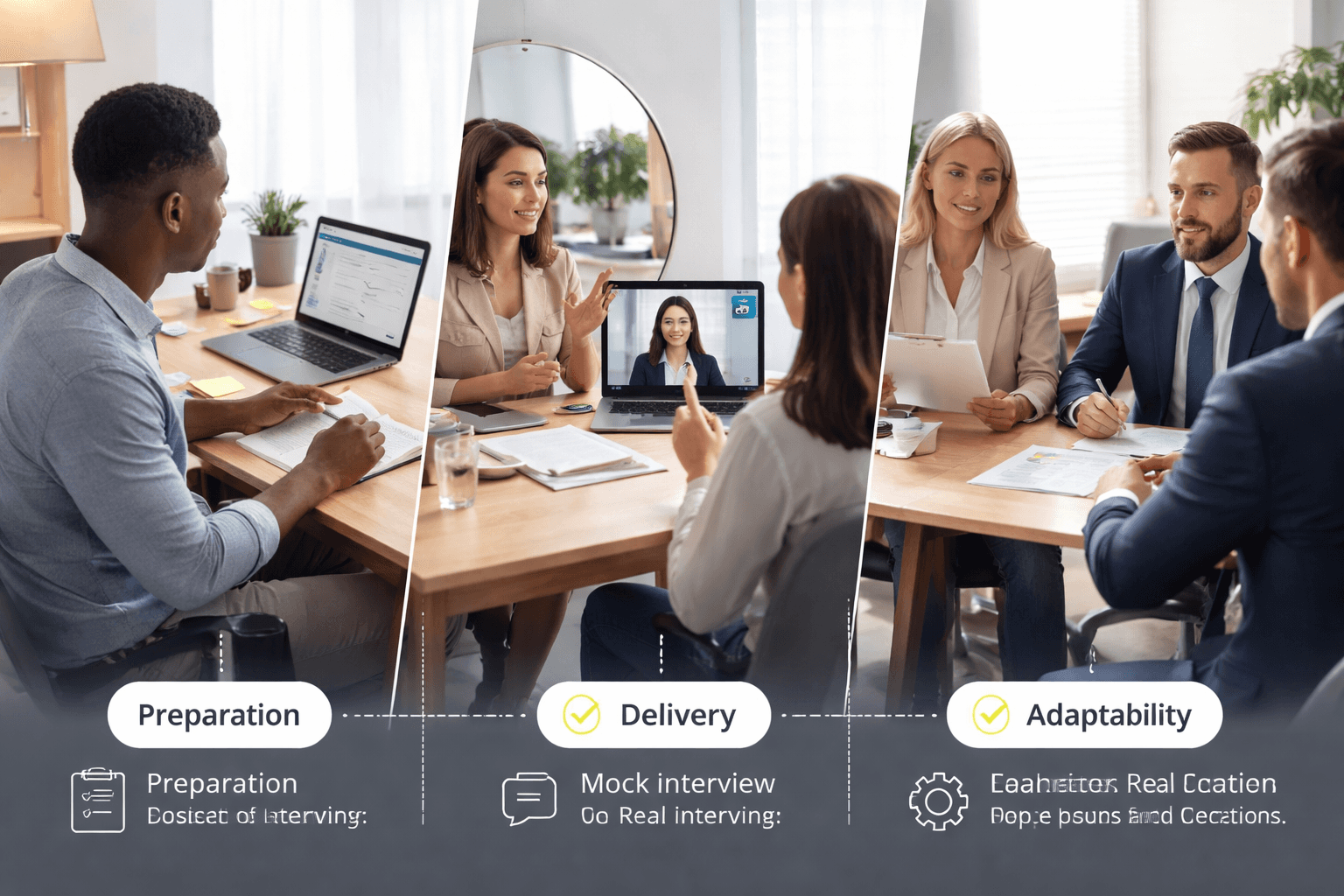
This leads to an important conclusion. Neither AI tools nor mock interviews alone are enough to consistently deliver strong results. Each solves a different part of the problem, but relying on just one creates gaps in your preparation.
The Real Hiring Formula
Preparation: building structured, relevant answers efficiently, where AI tools are especially helpful
Delivery: communicating clearly and confidently under pressure, where mock interviews are essential
Adaptability: adjusting your responses in real time, which comes from combining both approaches
Real-time tools like Sensei AI can also play a role during actual interviews by helping reduce hesitation and quickly structuring responses when candidates feel stuck. This kind of support can be useful in high-pressure moments, but it works best when built on a solid foundation of prior preparation.
Understanding this balance is key—because once you know what actually drives hiring decisions, you can start building a strategy that reflects it.
Try Sensei AI Today!
When You Should Use AI vs Mock Interviews
Choosing between AI tools and mock interviews is not about picking one over the other—it’s about knowing when each approach is most effective. Different stages of preparation require different types of support, and using the right tool at the right time can significantly improve your results.
Use AI Tools When…
You’re early in preparation and need to understand common questions
You need repetition and idea generation to build structured answers
You’re preparing for technical or structured interviews where clarity matters
At this stage, AI helps you build a strong foundation. It allows you to explore different ways to answer questions, refine your responses, and practice without pressure.
Use Mock Interviews When…
You need to build confidence under realistic pressure
You’re preparing for final or high-stakes interview rounds
Communication, storytelling, and delivery matter more than just content
This is where mock interviews become essential. They help you translate preparation into performance, ensuring that your answers sound natural and convincing.
Use Both When…
You want the best possible outcome
You’re applying to competitive roles where small differences matter
One effective strategy is to combine mock interviews with real-time AI support. For example, you can conduct a mock interview—whether it’s a video interview or a live session with a peer, mentor, or coach—and simultaneously use Sensei AI for real-time assistance.
This approach allows you to practice under realistic conditions without the pressure, while Sensei AI provides immediate guidance on how to structure your answers and tailor them to your personal experience. The combination offers a unique balance of realistic practice and instant support, helping you build both confidence and clarity in your delivery.
With this strategy in mind, the next step is to turn it into a clear, actionable plan you can follow.
Practice with Sensei AI
A Practical 7-Day Prep Plan
If you want to turn strategy into results, you need a clear and realistic plan. The following 7-day structure is designed to balance preparation and performance, helping you build both strong answers and confident delivery without overcomplicating the process.
Day 1–2: Build Your Foundation
Understand the role, key responsibilities, and common interview questions
Use AI tools to draft and structure your answers
Focus on clarity, relevance, and aligning answers with your experience
At this stage, the goal is not perfection, but direction. You are building the raw material for your responses.
Day 3–4: Practice Out Loud
Start answering questions verbally instead of just reading or writing
Refine your responses to sound more natural and less scripted
Pay attention to pacing, clarity, and how you explain your thinking
This step helps bridge the gap between knowing what to say and actually saying it well.
Day 5: Simulate Real Interviews
Conduct one or two mock interviews with a friend, mentor, or coach
Treat them seriously, as if they were real interviews
Take note of feedback, especially on delivery and confidence
Day 6: Improve Weak Areas
Identify patterns in your mistakes or struggles
Use AI tools again to refine specific answers or fill knowledge gaps
Focus on areas where you hesitated or lacked clarity
Day 7: Final Mock and Review
Do one final mock interview under realistic conditions
Review your performance and make small adjustments
Avoid over-practicing—focus on confidence and consistency
Throughout this process, the key is balance. Strong candidates combine solid knowledge with clear delivery. By following this plan, you are not just preparing more—you are preparing in a way that directly translates into better interview performance.
It’s Not AI vs Mock Interviews—It’s How You Use Them
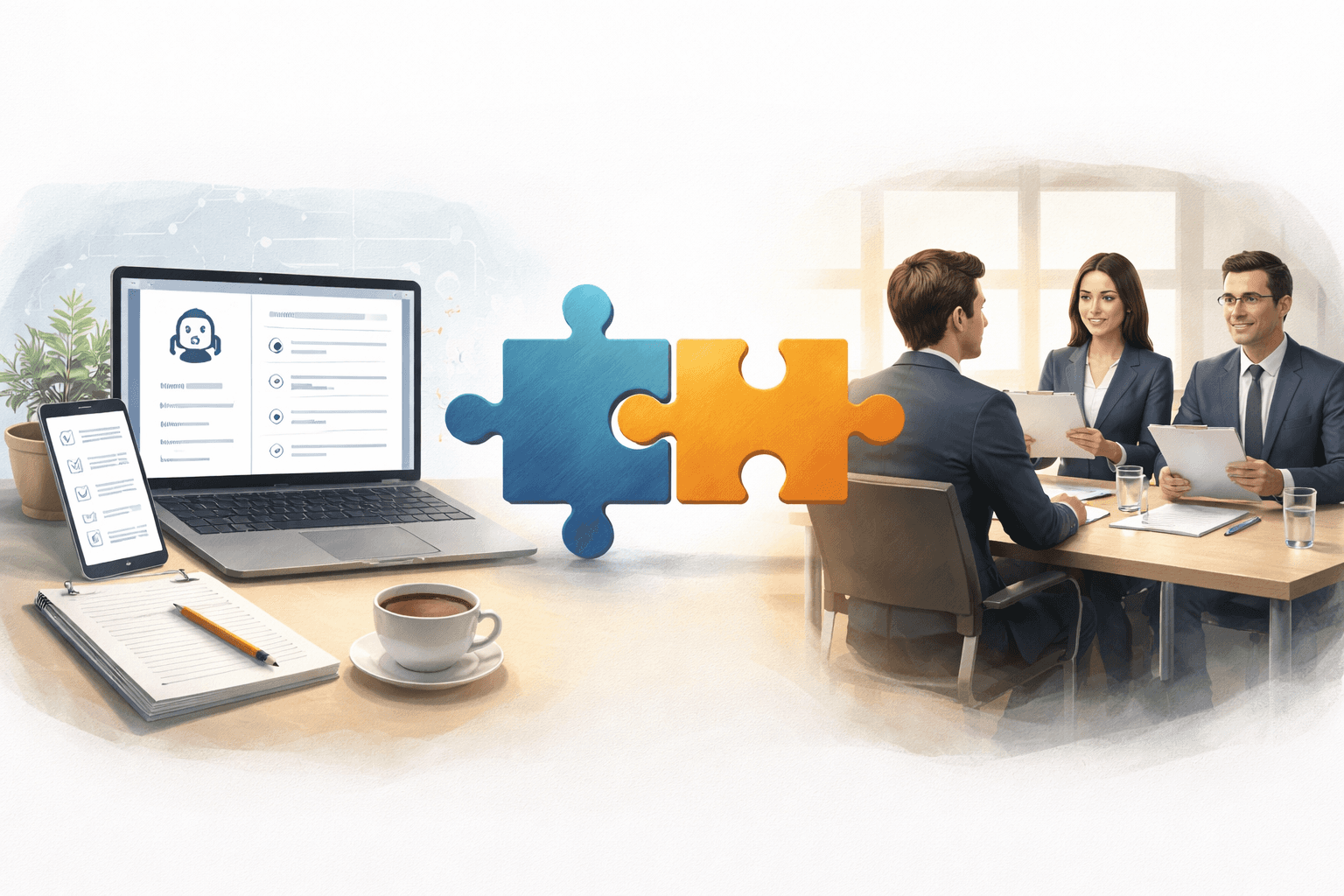
After comparing both approaches, the answer becomes clear: this is not about choosing one over the other. The real advantage comes from understanding how each method contributes to your success and using them in the right way at the right time.
AI tools act as a preparation engine. They help you organize your thoughts, generate structured answers, and practice efficiently. On the other hand, mock interviews function as performance training. They push you to communicate clearly, think under pressure, and present your ideas with confidence in a realistic setting.
Instead of overthinking which option is better, focus on how they complement each other. By integrating tools like Sensei AI with mock interviews, you get the best of both worlds—you can practice under realistic conditions with the added benefit of real-time AI assistance. This combination helps you structure your responses quickly and accurately, while still practicing your delivery under pressure.
Keep your approach simple and practical. Start by building strong answers with AI tools like Sensei AI, then practice delivering them in mock interview scenarios. Refine based on feedback, and you’ll improve both the quality of your responses and your performance in actual interviews. Consistency matters far more than complexity.
Most importantly, remember that successful candidates are not the ones who prepare the most, but the ones who prepare in the smartest way. By combining the strengths of both Sensei AI and mock interviews, you give yourself a clear, balanced path toward better performance—and ultimately, better results.
Try Sensei AI Now!
FAQs
Can AI take mock interviews?
AI tools, like Sensei AI, can assist in simulating mock interviews by providing real-time feedback and generating personalized responses based on your input. However, AI cannot fully replace the experience of an actual human conducting a mock interview. It excels in structuring answers and providing immediate suggestions but does not replicate the unpredictable nature of human interaction during interviews.
Do people really use AI for interviews?
Yes, more and more job seekers are using AI to prepare for interviews. AI tools are commonly used to simulate interview questions, help with real-time answers, and provide feedback on how to improve responses. Companies are also adopting AI for initial stages of hiring, such as screening resumes and conducting automated interviews. However, while AI is gaining traction in interview prep, it is still most effective as a supplement to human-driven practice.
Is an AI interview a red flag?
An AI interview in itself is not a red flag. Many companies use AI-powered tools for initial screenings or assessments, especially in large recruitment drives. These AI systems help streamline the process by evaluating candidate responses and sorting applicants more efficiently. However, a lack of transparency or over-reliance on AI without human involvement could raise concerns about fairness and bias, which is something candidates should consider.
Is AI better than humans at interviewing people?
AI is not necessarily "better" than humans at interviewing people. While AI can process information quickly, structure answers, and detect patterns in responses, it lacks emotional intelligence and the nuanced understanding that a human interviewer provides. AI excels in technical assessments, structured interviews, and high-volume recruitment but cannot replace the human element of assessing interpersonal skills, cultural fit, and emotional responses during interviews.

Shin Yang
Shin Yang est un stratégiste de croissance chez Sensei AI, axé sur l'optimisation SEO, l'expansion du marché et le support client. Il utilise son expertise en marketing numérique pour améliorer la visibilité et l'engagement des utilisateurs, aidant les chercheurs d'emploi à tirer le meilleur parti de l'assistance en temps réel aux entretiens de Sensei AI. Son travail garantit que les candidats ont une expérience plus fluide lors de la navigation dans le processus de candidature.
En savoir plus
Série de tutoriels : Présentation de notre nouvelle extension Chrome Listener
Sensei AI vs Interviewing.io: Which Interview Tool Is Better for You in 2026?
Sensei AI vs Huru: Which AI Interview Tool Is Better in 2026?
Sensei AI vs Interview Warmup: Which Interview Practice Tool Is Better in 2026?
How Recruiters Detect AI Answers (and How to Stay Authentic)
Interview Copilot vs Traditional Interview Coaching: Which Is Better for Your Next Interview?
Best AI for Behavioral Interview Questions: 9 Tools to Practice Smarter in 2026
Google Interview Warmup Alternatives: 9 Best Tools to Practice for Interviews in 2026
How to Practice for an Interview by Yourself: A Step-by-Step Guide That Actually Works
Best AI Tools for Job Seekers in 2026
Sensei AI
hi@senseicopilot.com