

Why the Questions You Ask Matter More Than Ever
Many candidates spend most of their interview preparation thinking about how to answer questions. They rehearse stories, review technical knowledge, and practice explaining their experience. But one important part of the interview is often overlooked: the questions you ask the interviewer.
In reality, interviews are no longer one-sided evaluations. In 2026, hiring has increasingly become a two-way conversation where both sides are trying to determine whether the opportunity is a good match. Employers are not only assessing your skills—they are also paying attention to how you think, how you evaluate opportunities, and how curious you are about the work.
Thoughtful questions often signal several important qualities employers care about:
preparation
critical thinking
long-term interest in the role
Recruiters frequently mention that the questions candidates ask can sometimes reveal more than the answers they give. A well-placed question can demonstrate strategic thinking, genuine engagement, and a deeper understanding of the role.
This has become even more important as hiring evolves. With AI-assisted recruiting, remote interviews, and faster hiring cycles, generic questions such as “What does a typical day look like?” often fail to make a strong impression.
In this guide, we will explore:
which questions impress interviewers the most
which questions candidates should avoid
how to adapt questions at different interview stages
how smart questions help you evaluate companies
Ultimately, asking the right questions can transform you from just another qualified candidate into a serious potential hire.
What Hiring Managers Actually Want to Hear From Candidates
Many candidates assume interviewers are simply checking whether they can do the job. In reality, experienced hiring managers are also paying close attention to how candidates think. The questions you ask during an interview provide insight into your mindset, priorities, and professional maturity.
When interviewers invite candidates to ask questions, they are often evaluating deeper signals. A thoughtful question can demonstrate curiosity, strategic thinking, and an understanding of the bigger picture. On the other hand, generic or poorly prepared questions may suggest a lack of preparation.
What Interviewers Are Quietly Evaluating
In many interviews, the questions you ask are evaluated across several dimensions. These signals help hiring managers understand how you approach work, collaboration, and long-term growth.
Signal | What It Shows | Example Question |
|---|---|---|
Growth mindset | Candidate wants to improve and develop new skills | “What skills would someone in this role ideally develop in the first year?” |
Ownership | Candidate is thinking about long-term performance | “What does success look like in this role after 6 months?” |
Team awareness | Candidate values collaboration and communication | “How does this team typically work together on projects?” |
Strategic thinking | Candidate understands business priorities | “What challenges is the team trying to solve this year?” |
Thoughtful questions like these can significantly change the tone of an interview. Instead of feeling like a one-sided interrogation, the conversation becomes more like a professional discussion between colleagues exploring a potential partnership.
Because of this, preparing your questions before the interview is extremely important. Candidates who arrive with clear, thoughtful questions often appear more confident, engaged, and genuinely interested in the role.
Some candidates also rely on tools such as Sensei AI, a real-time interview copilot that detects interviewer questions and generates answers by referencing your resume and other context. During fast-paced interviews, this type of support can also help candidates quickly think through follow-up ideas and stay focused on the conversation.
Try Sensei Ai for Free
The 10 Smartest Questions to Ask the Interviewer in 2026
Many candidates assume the goal of an interview is simply to provide strong answers. However, the most memorable candidates also ask thoughtful questions. The best questions usually focus on impact, growth, and team dynamics. These topics show that you are thinking beyond getting the job and are already considering how you would contribute and develop within the organization.
Instead of asking generic questions that could apply to any company, strong candidates ask questions that explore expectations, priorities, and collaboration. The right question can demonstrate curiosity, maturity, and professional awareness.
Questions That Make You Stand Out
What does success look like for this role in the first 90 days?
Why it works: This question shows that you are focused on delivering value quickly. It also helps you understand the most important priorities during the early stage of the role.
What are the biggest challenges someone in this role will face?
Why it works: Every job comes with challenges. Asking this question signals that you are realistic, proactive, and willing to solve problems rather than avoid them.
How does this team measure performance and progress?
Why it works: This demonstrates that you care about accountability and measurable outcomes. It also helps clarify how your work will be evaluated.
What recent project has the team been most proud of?
Why it works: This encourages the interviewer to share a success story and gives you insight into the team’s strengths, priorities, and working style.
How does the company support learning and skill development?
Why it works: Employers appreciate candidates who value continuous learning. This question highlights your interest in professional growth and long-term improvement.
What traits make someone thrive in this company culture?
Why it works: Cultural alignment matters in most organizations. This question shows that you want to understand how people collaborate and succeed in the environment.
What are the most important priorities for the team this year?
Why it works: Asking about priorities indicates that you are thinking strategically and want to understand how your potential role connects to larger goals.
How does the company approach innovation or experimentation?
Why it works: This question reveals how the organization handles new ideas, risk, and creativity, which are increasingly important in modern workplaces.
How does leadership communicate company goals to teams?
Why it works: Clear communication from leadership is essential for effective teams. This question helps you understand transparency and alignment inside the company.
What does career progression typically look like from this role?
Why it works: This shows long-term interest and ambition while also helping you understand possible growth opportunities.
When candidates ask questions like these, interviews become more meaningful conversations rather than simple question-and-answer sessions. Thoughtful questions demonstrate that you are not just searching for a job—you are looking for the right environment to contribute and grow.
Questions to Ask at Different Stages of the Interview Process
Not every interview stage requires the same type of question. Strong candidates understand that interviews usually happen in several rounds, and each round serves a different purpose. Because of this, the most effective candidates adapt their questions depending on who they are speaking with and what stage of the process they are in.
For example, an early conversation with a recruiter focuses more on confirming role expectations and basic alignment. Later interviews with hiring managers or team members usually focus on responsibilities, performance expectations, and collaboration. By the final stage, candidates are often expected to ask broader questions about leadership, strategy, and long-term growth.
Adapting your questions in this way helps demonstrate preparation and awareness. It also shows that you understand the structure of the hiring process and are thinking carefully about how you might contribute to the organization.
Stage-Based Question Strategy
Interview Stage | Best Questions to Ask | Purpose |
|---|---|---|
Recruiter screening | Questions about role scope, responsibilities, and expectations | Confirm whether the role fits your skills and career goals |
Hiring manager interview | Questions about team priorities, projects, and success metrics | Understand the real impact of the role and how your work would contribute |
Technical interview | Questions about tools, workflow, and problem-solving approaches | Demonstrate technical awareness and curiosity about how the team operates |
Final round | Questions about company direction, leadership vision, and long-term goals | Show strategic thinking and long-term interest in the organization |
Another important tip is to avoid repeating questions that were already answered earlier in the process. Before each new interview round, review what you have already learned and prepare fresh questions that build on previous conversations.
Some candidates also use tools such as Sensei AI, which can listen to interviewer questions and generate structured responses in real time based on the candidate’s resume and role context. Because responses can be customized in tone and structure, candidates can quickly adjust how they communicate whether they are speaking with recruiters, engineers, or senior leaders.
Practice with Sensei Ai
Questions You Should Avoid Asking
Asking thoughtful questions can strengthen your impression during an interview. However, the opposite is also true. Certain questions can unintentionally create negative impressions and signal poor preparation or misplaced priorities. Even well-qualified candidates sometimes weaken their interviews by asking questions that suggest they have not researched the company or carefully considered the role.
Interviewers often interpret poorly chosen questions as signs that a candidate is disengaged, unprepared, or primarily motivated by short-term benefits. This is why preparing questions in advance is just as important as preparing answers.
Common Question Mistakes
Several types of questions tend to create weaker impressions during interviews.
Questions easily answered on the company website
Example:
Bad: “What does your company do?”
Better: “How does this team contribute to the company’s overall goals?”
Questions focused only on benefits too early
Example:
Bad: “How many vacation days do employees get?”
Better: “How does the team typically balance workload during busy periods?”
Questions showing lack of preparation
Example:
Bad: “What kind of projects does this team work on?”
Better: “I saw that the team recently worked on product expansion. What challenges came up during that project?”
Questions that sound negative or critical
Example:
Bad: “Why do people leave this team so often?”
Better: “What qualities help people succeed and stay long term on this team?”
Questions about salary too early in the process
Example:
Bad: “How much does this job pay?”
Better: “How is performance typically evaluated in this role?”
With thoughtful preparation, these common mistakes are easy to avoid. Researching the company, reviewing the job description carefully, and preparing several flexible questions will help ensure that your questions strengthen your interview rather than weaken it.
How to Prepare Your Questions Before the Interview
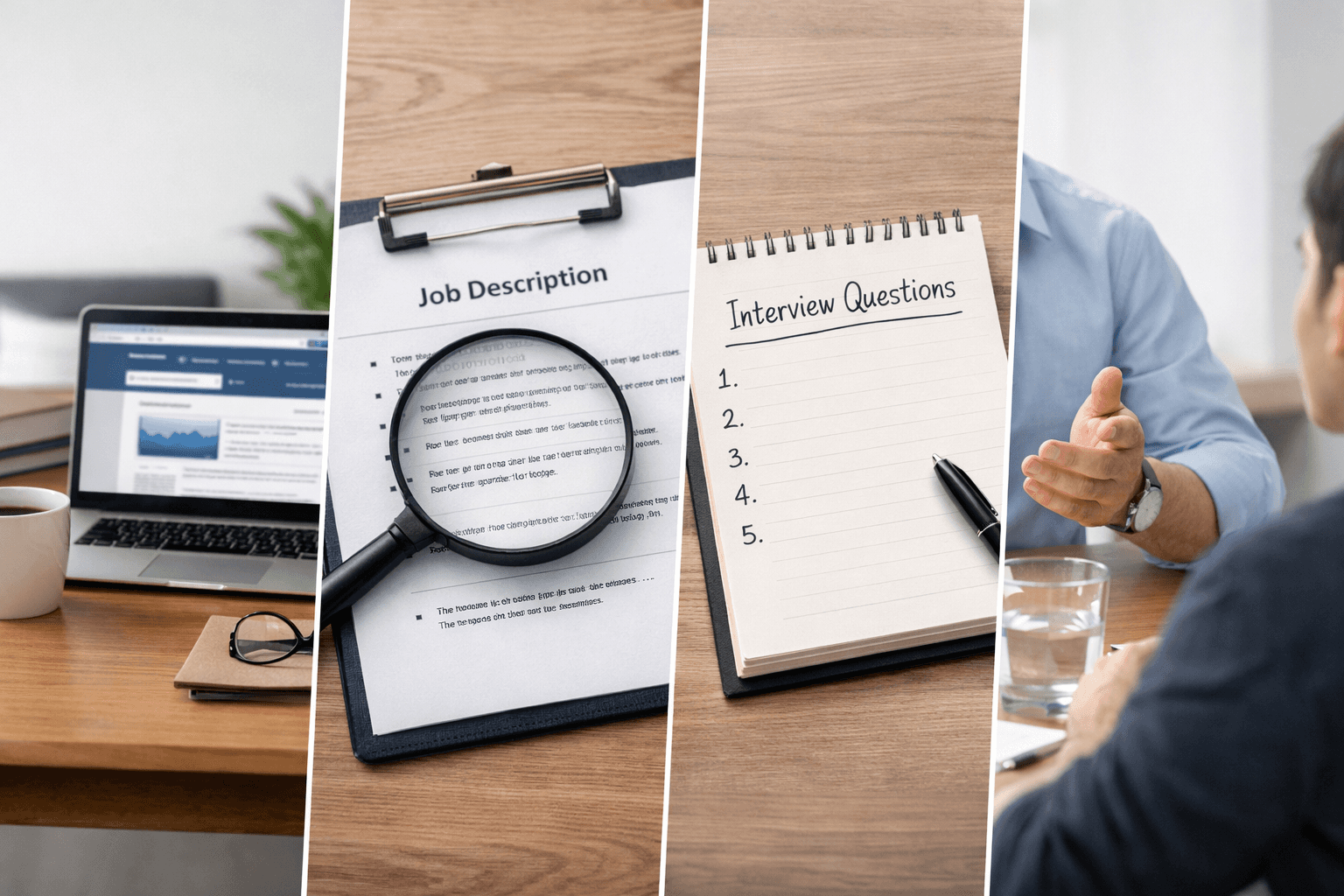
Many candidates think of interview questions as something they will improvise at the end of the conversation. In reality, strong candidates prepare their questions in advance just as carefully as they prepare their answers. Preparing thoughtful questions helps you stay confident during the interview and ensures that you ask meaningful questions rather than generic ones.
A structured preparation process can make this much easier. Instead of trying to invent questions on the spot, candidates can build a small list of questions that explore the role, the team, and the company’s goals.
A Simple 4-Step Preparation Method
Step 1 – Research the company
Start by reviewing the company’s website, recent news, and product updates. Understanding the organization’s mission, industry position, and recent developments will help you ask questions that feel informed and relevant.
Step 2 – Analyze the job description
Carefully read the job description and identify the responsibilities that stand out. Look for keywords related to priorities, tools, or projects. These details can inspire questions about expectations, workflows, or success metrics.
Step 3 – Prepare 5–6 flexible questions
Before the interview, prepare several questions that cover different topics such as team collaboration, performance expectations, and growth opportunities. Flexible questions can easily be adapted depending on how the conversation develops.
Step 4 – Adapt based on interview flow
During the interview, listen carefully to what the interviewer already explains. If one of your prepared questions is answered naturally, move to another question that builds on the conversation.
In most interviews, you may only have time to ask two or three questions. Because of this, it is helpful to prepare more questions than you actually plan to ask so you can choose the most relevant ones.
Some candidates also use Sensei AI’s AI Playground, a conversational AI environment designed to answer interview and career questions. It can help users brainstorm thoughtful questions to ask interviewers or explore different ways to phrase them before an interview.
Try Sensei Ai Now!
A Simple Framework for Choosing the Best Question in the Moment
Even when candidates prepare several questions in advance, interviews rarely follow a perfectly predictable structure. Conversations can shift quickly depending on the interviewer’s focus, the topics discussed, or the time available at the end. Because of this, strong candidates learn to choose questions based on how the conversation develops rather than simply reading from a prepared list.
One practical way to do this is by using a simple mental framework that helps you quickly identify which type of question might be most relevant at that moment.
The IMPACT Question Framework
The IMPACT framework organizes questions into six useful categories that cover the most important areas candidates typically want to explore.
I – Insight (learn about the company)
Questions in this category help you understand how the company operates, what it values, and how teams collaborate across the organization.
M – Metrics (understand success criteria)
These questions focus on how performance is evaluated, what outcomes matter most, and how success is measured within the role.
P – People (team dynamics)
Questions about people help you learn how the team communicates, collaborates, and supports each other in daily work.
A – Ambition (future direction)
These questions explore the company’s goals, growth plans, and long-term strategic priorities.
C – Challenges (current problems)
This category focuses on obstacles the team is currently facing and what problems they are trying to solve.
T – Timeframe (short- vs long-term priorities)
Questions here clarify what matters most in the coming months versus the coming years.
Using this framework allows candidates to quickly select a relevant question depending on what has already been discussed during the interview. Instead of sounding rehearsed, the conversation feels more natural and thoughtful because the question connects directly to the discussion that just took place.
Final Thoughts: Great Interviews Are Conversations, Not Interrogations

Many candidates treat interviews as one-sided evaluations where their only responsibility is to provide strong answers. In reality, the most successful interviews feel more like professional conversations. When candidates ask thoughtful questions, the discussion becomes more balanced and meaningful for both sides.
Asking strong questions demonstrates several qualities that employers value. It shows that you prepared carefully for the interview, that you are genuinely curious about the role, and that you are thinking seriously about how you would contribute to the team. At the same time, your questions help you evaluate whether the company truly aligns with your goals and expectations.
Thoughtful questions can also influence how interviewers perceive you. A candidate who asks insightful questions often appears more engaged, more strategic, and more invested in long-term success.
For this reason, it is helpful to prepare five to seven thoughtful questions before every interview. Having several options ensures that you can adapt to different interviewers and choose the most relevant questions during the conversation.
As hiring continues to evolve with AI-assisted recruiting, remote interviews, and faster hiring cycles, candidates who demonstrate curiosity, strategic thinking, and strong communication skills will continue to stand out in competitive job markets.
FAQs
What are the top 5 questions to ask an interviewer?
What does success look like in the first 90 days for this role? – Shows you are outcome-focused.
What are the biggest challenges someone in this role will face? – Demonstrates curiosity about real-world obstacles.
How does this team measure performance and progress? – Indicates interest in metrics and accountability.
What traits make someone thrive in this company culture? – Signals attention to alignment with company values.
How does leadership communicate company goals to teams? – Highlights strategic thinking and long-term perspective.
What are the top 5 most asked interview questions?
Tell me about yourself. – Opens the conversation and tests communication skills.
Why do you want to work here? – Measures motivation and cultural fit.
What are your strengths and weaknesses? – Evaluates self-awareness and honesty.
Describe a challenge you faced and how you overcame it. – Looks for problem-solving and resilience.
Where do you see yourself in 5 years? – Assesses career goals and alignment with company growth.
What to wear to a job interview in 2026?
Corporate/Finance roles: Dark suit, conservative tie or blouse, polished shoes.
Tech/Startup roles: Smart casual, neat shirt or blouse, tailored pants or skirt, clean shoes.
Creative roles: Business casual with personal style touches, avoid overly casual clothing.
General tips: Keep accessories minimal, ensure clothes are clean and pressed, and avoid overly flashy colors.
What is the 30-60-90 question in an interview?
The 30-60-90 question asks candidates to outline what they would aim to achieve in their first 30, 60, and 90 days on the job.
Purpose: Evaluates planning, prioritization, and understanding of role responsibilities.
How to answer: Highlight realistic short-term goals, progressive milestones, and how you will measure success in each phase.
Example: “In the first 30 days, I would focus on learning team processes; by 60 days, start contributing to ongoing projects; and by 90 days, take ownership of a key initiative.”

Shin Yang
Shin Yang est un stratégiste de croissance chez Sensei AI, axé sur l'optimisation SEO, l'expansion du marché et le support client. Il utilise son expertise en marketing numérique pour améliorer la visibilité et l'engagement des utilisateurs, aidant les chercheurs d'emploi à tirer le meilleur parti de l'assistance en temps réel aux entretiens de Sensei AI. Son travail garantit que les candidats ont une expérience plus fluide lors de la navigation dans le processus de candidature.
En savoir plus
Série de tutoriels : Présentation de notre nouvelle extension Chrome Listener
Good Excuses to Leave Work Early: 25 Professional Reasons That Won't Hurt Your Reputation
Should Your Resume Sound Like ChatGPT? The Right Balance Between AI Writing and Authenticity
Resume Mistakes AI Notices Before Humans Do (And How to Fix Them Before You Apply)
Les pires conseils d'entretien auxquels les gens croient encore (et ce qui fonctionne vraiment à la place)
Ce que les recruteurs aimeraient que les candidats sachent : 11 secrets pour vous faire embaucher plus rapidement
LinkedIn Profile Checklist 2026: 27 Updates That Make Recruiters Want to Click "Message"
LinkedIn Profile Before vs After Examples: 15 Real Transformations That Attract Recruiters
Pourquoi les recruteurs vous interrompent : 10 vraies raisons (et comment y répondre sans perdre confiance)
The Hidden Metadata Recruiters Can See (And What It Really Says About You)
Sensei AI
hi@senseicopilot.com