
Why LinkedIn Outreach Matters More Than Ever in 2026
LinkedIn is no longer just an online resume. According to LinkedIn’s official statistics page, the platform now has over 1 billion users worldwide. That scale changes how hiring works. When everyone is applying with one click, visibility becomes the real advantage.
At the same time, multiple hiring reports from LinkedIn and Jobvite consistently show that an estimated 60–70% of roles are filled through networking or referrals rather than cold applications. This is often called the “hidden job market.” In practical terms, it means the majority of successful candidates didn’t just submit an application—they had a conversation first.
The difference between a cold application and a warm introduction is context. A resume sent into a system competes with hundreds of others. A message sent directly to a recruiter or hiring manager creates recognition before your name ever appears in an applicant tracking system.
In 2026, response rates depend less on having perfect credentials and more on positioning. How clearly you communicate relevance, intent, and value matters more than listing every achievement.
What Changed in 2026?
AI-assisted hiring tools now screen resumes faster than ever. Recruiters are flooded with automated applications generated at scale. As a result, generic messages blend together.
Personalization now beats mass messaging. Short, intentional outreach messages outperform long paragraphs that feel templated. The people who get replies are not necessarily the most qualified—they are the most intentional.
Outreach isn’t about asking for a job. It’s about starting a conversation.

The Psychology Behind a Reply
Getting a response on LinkedIn isn’t random. It follows predictable behavioral patterns. Recruiters and hiring managers skim quickly, prioritize relevance, and ignore anything that feels automated. If your message doesn’t immediately answer “Why me?” and “Why now?”, it gets archived.
Why Most LinkedIn Messages Get Ignored
Most outreach fails for four simple reasons.
First, generic copy-paste templates feel obvious. If your message could be sent to 200 other people unchanged, it signals low effort.
Second, asking for a referral immediately creates pressure. Relationships don’t start with favors.
Third, overly long messages require too much attention. Busy professionals don’t read essays in their inbox.
Fourth, no context. If the recipient can’t instantly understand why you’re reaching out, they move on.
Short, specific, low-pressure messages consistently outperform everything else.
The 4-Part Formula That Works
Below is a simple structure that increases reply rates while keeping your message natural.
Component | What It Does | Example Line |
|---|---|---|
Context | Explains why you’re reaching out | “I saw your post about scaling the data team at X Company.” |
Credibility | Shows why you specifically | “I’ve been working on similar backend optimization projects.” |
Relevance | Connects your background to their needs | “Your team’s focus on distributed systems caught my attention.” |
Low-friction ask | Makes it easy to respond | “Would you be open to a quick 10-minute chat?” |
This structure works because it reduces cognitive load. The recipient understands your intent within seconds.
Preparing for outreach conversations also matters. Many “quick chats” turn into informal screening calls where you’re asked about your background or technical experience.
When those conversations turn into interviews, tools like Sensei AI can help in real time by listening to interview questions and generating answers based on your uploaded resume and role details. It works hands-free and responds in under a second, which makes it useful if a casual networking chat suddenly becomes technical.
Try Sensei AI for Free
LinkedIn Outreach Scripts for Recruiters
Recruiters are often your first point of contact in the hiring process. Their job is to filter quickly, identify alignment, and move qualified candidates forward. Your outreach should make that job easier—not harder. Below are practical scripts you can adapt depending on your situation.
Script 1: Cold Recruiter Outreach
Hi [Name],
I came across your post about [X] and noticed you're hiring for [Role]. I recently worked on [specific skill/project], and I’m exploring opportunities in this space.
Would you be open to a quick chat about what you're looking for in candidates this year?
This works because it’s specific and low-pressure. You reference something real, demonstrate relevance, and end with a soft ask. You’re not demanding a referral or an interview. You’re starting a conversation. That subtle difference increases response rates significantly.
Script 2: After Applying
Hi [Name],
I just applied for the [Role] position and wanted to introduce myself directly. My background in [X] aligns closely with the team’s focus on [Y].
If helpful, I’d love to share more context around my experience.
Timing matters here. Send this within 24–48 hours of applying. The tone should feel professional but calm. You’re reinforcing your application, not pushing for immediate feedback. Keep it concise and aligned with the job description.
Script 3: Following Up Without Being Annoying
Hi [Name],
Just wanted to briefly follow up on my previous message regarding the [Role] position. I understand things get busy, but I remain very interested and would appreciate any updates when convenient.
Spacing is key. Wait 5–7 business days before following up. Recruiters often manage dozens of open roles simultaneously, so delays are normal. A short, respectful follow-up shows professionalism without creating pressure.

Outreach Scripts for Hiring Managers
Reaching out to a hiring manager is different from messaging a recruiter. Recruiters focus on pipeline and screening across multiple roles. Hiring managers, on the other hand, care deeply about team fit, execution ability, and solving specific problems. Your message should reflect that difference.
When you contact a hiring manager, your goal isn’t just visibility. It’s alignment. Show that you understand what their team is building and how you contribute directly.
When to Message a Hiring Manager
There are situations where contacting the hiring manager makes strategic sense.
Smaller companies often have lean recruiting teams, so managers are more directly involved in reviewing candidates.
Technical roles benefit from direct outreach because managers value demonstrated skill and measurable results over generic summaries.
Startup environments typically reward initiative. A thoughtful message can signal ownership and proactive thinking.
If the organization is large and highly structured, recruiters are usually the better first contact.
Direct but Respectful Script
Hi [Name],
I’ve been following [Company]’s work in [area], especially the recent [initiative]. I’m applying for the [Role] and wanted to reach out directly. My background in [X] includes [specific measurable achievement].
If there’s anything specific you're prioritizing in candidates, I’d appreciate your insight.
Metrics matter because they reduce ambiguity. Saying “improved performance” is vague. Saying “reduced API latency by 32%” is concrete. Hiring managers think in outcomes, not adjectives.
If they respond with deeper technical or behavioral questions, be prepared. Direct outreach often accelerates the evaluation process.
If that conversation quickly shifts into live technical or behavioural questions, Sensei AI can provide real-time interview assistance by detecting the interviewer’s questions and generating tailored answers using your resume. It’s particularly useful for coding interviews thanks to its Coding Copilot feature across platforms like HackerRank and CoderPad.
Practice with Sensei Ai
Alumni and Warm Networking Scripts
Warm outreach consistently outperforms cold messaging because it starts with shared context. When there’s common ground—same university, mutual connection, shared community—the interaction feels natural rather than transactional. The goal here isn’t to ask for a job. It’s to build familiarity and trust.
Alumni Outreach Script
Hi [Name],
I noticed we both graduated from [University], and I’ve been following your path into [industry/role]. I’m currently exploring similar opportunities and would really value your perspective on breaking into this space.
If you’re open to it, I’d appreciate a brief chat sometime in the coming weeks.
Alumni connections lower the psychological barrier. There’s an implicit sense of shared experience, which increases reply likelihood.
Second-Degree Connection Script
Hi [Name],
I saw that we’re both connected to [Mutual Contact]. I’ve been interested in [Company/Field] and came across your profile while researching. Your work on [specific project or focus] stood out to me.
Would you be open to a short conversation about your experience?
Referencing a mutual contact builds immediate credibility. It signals you’re not reaching out randomly.
The Informational Interview Ask
Hi [Name],
I’m currently learning more about careers in [field] and came across your background. I’m not actively asking about openings, but I’d genuinely appreciate hearing about your journey and any advice you’d share.
Would you have 15 minutes for a quick call?
This approach carries lower pressure and often results in higher reply rates. When you remove urgency and entitlement, people are more willing to engage.
Relationship-building always outperforms transactional messaging. Many referrals happen organically after a positive informal chat—without you ever directly asking for one.
Common Outreach Mistakes in 2026
Even strong candidates sabotage their own outreach by repeating the same avoidable mistakes. In 2026, the biggest issue is over-optimizing with AI-generated generic text. When a message sounds polished but impersonal, recruiters can tell. If it reads like something that could be sent to anyone, it usually gets ignored.
Writing essays is another common error. Long paragraphs create friction. Busy professionals scan quickly, and dense messages feel like work. Clarity beats length every time.
Asking for referrals immediately also backfires. Starting a conversation with a request for internal advocacy creates pressure before trust is built. Strong outreach focuses on dialogue first.
Sending identical messages to 50 people is equally ineffective. Mass messaging lowers response rates because it removes relevance. Personalization doesn’t require writing from scratch each time, but it does require context.
Finally, many candidates forget to optimize their LinkedIn profile before reaching out. If someone clicks your profile after receiving your message and finds it incomplete or unclear, momentum disappears.
Your Profile Is Part of the Message
Your banner should signal what you do or the field you’re targeting. Your headline should communicate value, not just a job title. The featured section can showcase projects, portfolios, or measurable achievements that reinforce credibility.
Before outreach turns into interviews, it also helps to prepare structured answers in advance. Sensei AI includes an AI Playground for practicing interview and career-related questions in a conversational format, and an AI Editor tool that helps generate resumes quickly if you need to refine yours before reaching out.
Try Sensei AI Now!
How to Track and Improve Your Response Rate
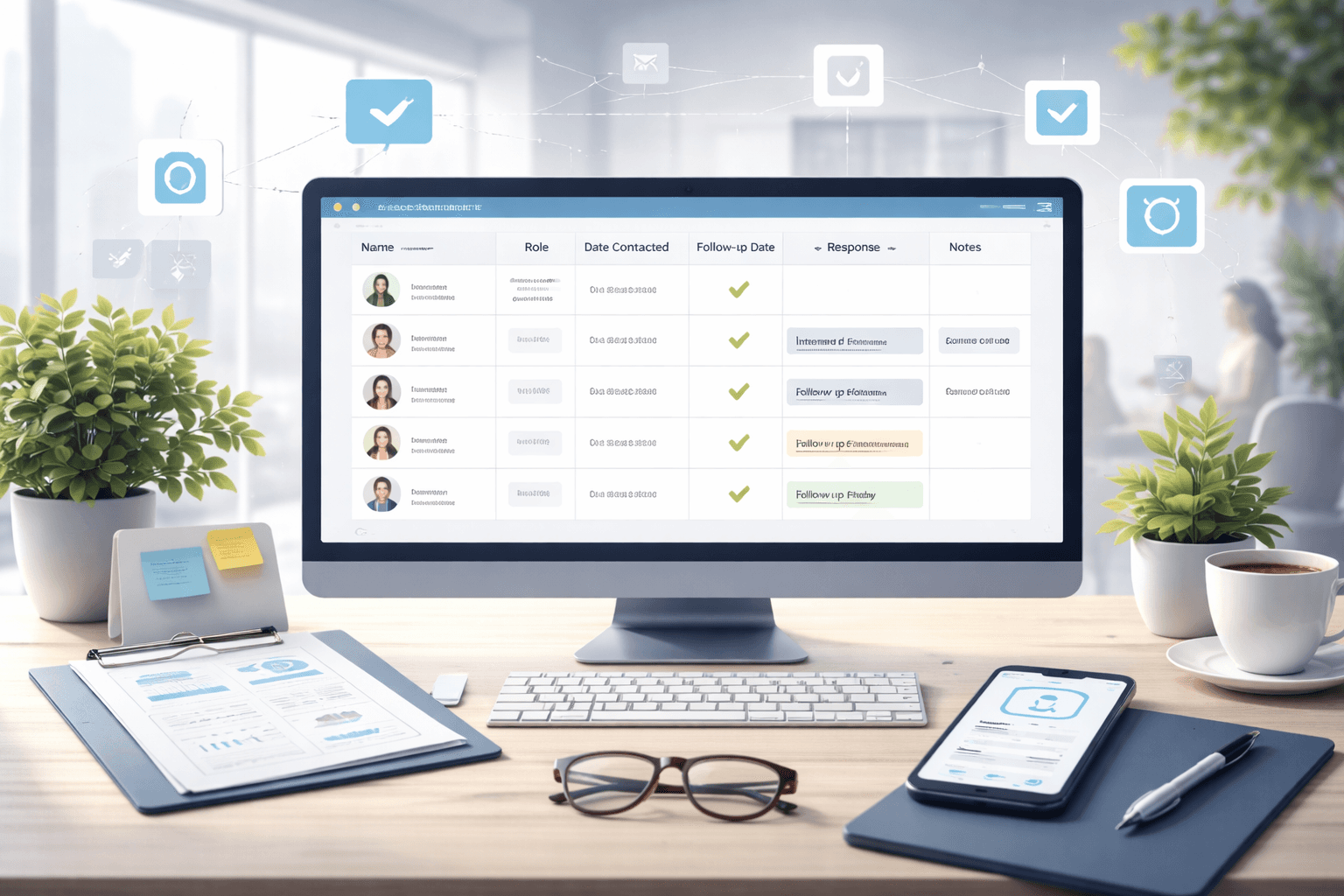
Outreach without tracking quickly turns into guesswork. If you don’t measure who you contacted, when you followed up, and what worked, it’s impossible to improve strategically. Treat outreach like a lightweight experiment rather than a one-time effort.
Simple Outreach Tracking System
You can create a simple spreadsheet with the following structure:
Name | Role | Date Contacted | Follow-up Date | Response | Notes |
|---|---|---|---|---|---|
Name helps you personalize future messages. Role gives context about the type of professional responding. Date Contacted ensures you don’t follow up too early. Follow-up Date keeps timing intentional. Response tracks outcomes. Notes allow you to document tone, advice given, or next steps.
A 10–20% reply rate for cold outreach is completely normal. If you send 20 thoughtful messages and receive three replies, that’s working. Personalization significantly increases your odds compared to generic outreach.
Follow-ups also matter. Multiple sales outreach studies show that a polite follow-up can nearly double reply probability compared to a single message. Many professionals simply miss the first message.
Experiment with message length, opening lines, and timing. Track what improves your response rate over time.
Outreach is a skill. The more intentional you are, the more it compounds.
FAQs
What is the 5-3-2 Rule on LinkedIn?
The 5-3-2 rule is a content-sharing guideline for social media, including LinkedIn. It suggests that for every 10 posts you make:
5 posts should share others’ content that is relevant to your audience.
3 posts should be your own original content that provides value or insights.
2 posts should be personal, behind-the-scenes, or light content that humanizes you.
This balance keeps your LinkedIn profile engaging, authoritative, and approachable without overwhelming your network with purely self-promotional material.
How to Grow on LinkedIn in 2026?
To grow on LinkedIn in 2026, focus on intentional engagement rather than mass connection requests:
Share and comment on content relevant to your industry to increase visibility.
Post original insights and case studies that demonstrate your expertise.
Engage in meaningful conversations in groups and threads.
Optimize your profile with clear headline, summary, and relevant keywords.
Experiment with short-form video and carousel posts, which continue to get higher reach in 2026 algorithms.
Consistency, authenticity, and value-driven posts are more effective than posting frequently without strategy.
How to Get 500+ Contacts on LinkedIn?
Reaching 500+ connections requires a strategic approach:
Start with people you know: colleagues, classmates, and industry peers.
Personalize connection requests instead of sending the default LinkedIn invitation.
Attend virtual and in-person events, webinars, and industry meetups, then connect with participants.
Engage with content from people you want to connect with before sending a request.
Share helpful posts and insights to attract organic connection requests.
Once you reach 500+, your profile appears more established, which can boost credibility and visibility on LinkedIn.
What is the 4-1-1 Rule on LinkedIn?
The 4-1-1 rule is another content strategy for LinkedIn:
4 pieces of content should sha

Shin Yang
Shin Yang is a growth strategist at Sensei AI, focusing on SEO optimization, market expansion, and customer support. He uses his expertise in digital marketing to improve visibility and user engagement, helping job seekers make the most of Sensei AI's real-time interview assistance. His work ensures that candidates have a smoother experience navigating the job application process.
Learn More
Tutorial Series: Introducing Our New Chrome Extension Listener
Sensei AI vs Interviewing.io: Which Interview Tool Is Better for You in 2026?
Sensei AI vs Huru: Which AI Interview Tool Is Better in 2026?
Sensei AI vs Interview Warmup: Which Interview Practice Tool Is Better in 2026?
How Recruiters Detect AI Answers (and How to Stay Authentic)
Interview Copilot vs Traditional Interview Coaching: Which Is Better for Your Next Interview?
Best AI for Behavioral Interview Questions: 9 Tools to Practice Smarter in 2026
Google Interview Warmup Alternatives: 9 Best Tools to Practice for Interviews in 2026
How to Practice for an Interview by Yourself: A Step-by-Step Guide That Actually Works
Best AI Tools for Job Seekers in 2026
Sensei AI
hi@senseicopilot.com