

Why Algorithmic Interviews Feel Intimidating
If you’ve ever walked out of a technical interview thinking, “I know how to code… so what just happened?” — you’re not alone.
Algorithmic interviews have become a standard part of software engineering hiring. From startups to Big Tech, candidates are often asked to solve structured coding problems under time pressure. These interviews usually resemble questions you might see on platforms like LeetCode, HackerRank, or CodeSignal. For many developers, they feel less like real-world engineering and more like a competitive puzzle round.
The anxiety doesn’t usually come from lack of intelligence or even lack of experience. It comes from misunderstanding the format. Algorithmic interviews are not simply testing whether you can write working code. They evaluate how you approach unfamiliar problems, how clearly you think, and how you communicate your reasoning while the clock is ticking.
Time pressure adds another layer. You’re expected to clarify requirements, propose an approach, implement it, and analyze complexity — all within 30 to 45 minutes. That combination can make even strong developers freeze.
Why “knowing how to code” is different from “passing algorithmic interviews”
Writing production code is about building systems carefully over time. Passing an algorithmic interview is about demonstrating structured problem solving quickly and clearly. These are related skills — but they are not the same.
So what exactly are algorithmic interviews? What are interviewers really looking for? And how can you prepare in a way that feels strategic instead of overwhelming? Let’s break it down.

What Is an Algorithmic Interview?
An algorithmic interview is a structured technical interview where candidates solve coding problems designed to test their understanding of data structures and algorithms. Instead of building a full product or debugging an existing codebase, you are asked to solve a well-defined computational problem in real time.
These interviews typically focus on core computer science foundations. On the data structure side, that includes arrays, linked lists, trees, graphs, heaps, and hash maps. On the algorithm side, you’ll often encounter patterns such as two pointers, sliding window, depth-first search (DFS), breadth-first search (BFS), dynamic programming, and greedy strategies.
The goal isn’t just to see if you can arrive at a correct answer. Interviewers want to observe how you think. Can you break down a problem? Can you recognize patterns? Can you reason about trade-offs between time and space complexity? Algorithmic interviews are structured specifically to surface those signals.
How They Typically Work
Most algorithmic interviews follow a predictable flow:
You’re given a problem statement.
You clarify requirements and constraints.
You propose an initial approach.
You implement the solution.
You optimize if necessary.
You discuss time and space complexity.
This process is as important as the final solution. A perfect answer delivered without explanation is often weaker than a thoughtful solution explained clearly.
Below is a simple comparison to highlight how algorithmic interviews differ from everyday coding work:
Category | Traditional Coding | Algorithmic Interview |
|---|---|---|
Goal | Build features or systems | Demonstrate structured problem solving |
Environment | Collaborative, long-term | Timed, individual, high pressure |
Evaluation Focus | Maintainability, scalability | Logic, patterns, complexity analysis |
Time Pressure | Flexible deadlines | 30–45 minutes per problem |
This model became especially popular as large technology companies scaled hiring globally. Standardized algorithmic interviews made it easier to compare thousands of candidates consistently.
But why do companies rely so heavily on this format in the first place? Let’s explore the reasoning behind it.
Why Companies Use Algorithmic Interviews
From a hiring manager’s perspective, algorithmic interviews are less about trick questions and more about decision efficiency. When a company receives hundreds or even thousands of applications for a single engineering role, it needs a scalable and standardized way to evaluate candidates fairly.
Algorithmic interviews provide that structure.
First, they scale. A well-designed problem can be used across teams and locations, making it easier to compare candidates consistently. Second, they reduce ambiguity. Instead of relying on subjective impressions, interviewers can assess observable problem-solving behaviors. Third, they improve the signal-to-noise ratio. A candidate may have an impressive résumé, but a live problem-solving session reveals how they think under constraints.
Research in industrial-organizational psychology has repeatedly shown that structured interviews tend to have higher predictive validity than unstructured conversations. While algorithmic interviews are not perfect, their standardized format helps companies make more data-informed hiring decisions.
What Interviewers Are Actually Measuring
Despite the focus on code, interviewers are evaluating broader skills:
Problem decomposition — Can you break a complex task into manageable steps?
Communication clarity — Can you explain your reasoning logically and concisely?
Edge case thinking — Do you anticipate unusual or boundary inputs?
Code correctness — Does your implementation work and handle constraints properly?
Time and space complexity awareness — Can you analyze efficiency and discuss trade-offs?
Importantly, solving the entire problem perfectly is not always required to perform well. Structured reasoning, thoughtful discussion of trade-offs, and clear communication can still demonstrate strong engineering ability — even if the final solution isn’t fully optimized.
So what kinds of problems show up most often in these interviews?

The Most Common Algorithmic Question Categories
Understanding categories is more effective than randomly solving hundreds of problems. Most algorithmic interview questions fall into recognizable buckets. Once you learn the patterns, preparation becomes much more focused.
Arrays and Strings
These questions test indexing logic, iteration control, and space optimization.
Example: Given an array of integers, find two numbers that add up to a target value.
Common mistakes include ignoring edge cases like duplicate values, failing to consider time complexity (using nested loops instead of a hash map), or overlooking empty inputs. Arrays and strings often reward careful thinking about traversal patterns.
Linked Lists
Linked list problems evaluate pointer manipulation and memory awareness.
Example: Reverse a singly linked list in-place.
Candidates often struggle with losing references to the next node or mishandling edge cases such as a single-node list. These questions test whether you can reason step-by-step without visual confusion.
Trees and Graphs
These assess recursive thinking and traversal strategies.
Example: Perform a level-order traversal of a binary tree.
Common errors include mixing up depth-first and breadth-first search, forgetting base conditions, or misunderstanding how to manage visited nodes in graphs.
Dynamic Programming
Dynamic programming measures your ability to break problems into overlapping subproblems.
Example: Find the maximum sum of non-adjacent elements in an array.
Many candidates jump into coding before identifying the recurrence relation. Others fail to recognize when memoization is sufficient instead of building a full DP table.
Systematic Patterns (Two Pointers, Sliding Window, etc.)
These patterns test efficiency and optimization skills.
Example: Find the longest substring without repeating characters.
Mistakes often involve incorrect window updates or unnecessary recomputation, leading to higher-than-needed time complexity.
Pattern recognition matters more than memorizing 500 problems. Once you understand underlying structures, unfamiliar questions start to look familiar.
For candidates practicing mock interviews, tools like Sensei AI can provide real-time interview assistance by detecting interviewer questions and generating structured answers based on your resume and role context. It works hands-free and responds quickly, which can help reduce cognitive overload during live interviews.
Try Sensei AI for Free
How to Prepare Strategically (Without Burning Out)
Grinding hundreds of random problems might feel productive, but it often leads to frustration and slow improvement. A smarter approach focuses on structure, repetition, and deliberate reflection.
Step 1 — Build Foundations
Start with core data structures: arrays, hash maps, stacks, queues, linked lists, trees, and graphs. Make sure you understand how they work internally, their time complexities, and when to use each one.
Instead of solving 20 unrelated problems in one sitting, use spaced repetition. Revisit the same patterns over several weeks. Re-implement solutions from memory. Explain them without looking at notes. Mastery comes from reinforcement, not volume.
Step 2 — Practice Pattern Clusters
Group problems by pattern rather than difficulty level. For example, solve five sliding window problems in a row. Then switch to DFS or binary search variations.
This clustering builds recognition speed. Over time, you begin spotting structural similarities quickly. Random practice has diminishing returns because your brain never fully locks onto one pattern before switching contexts.
Step 3 — Simulate Real Interview Conditions
Many candidates only practice silently. That’s a mistake. In real interviews, communication is part of the evaluation.
Practice explaining your reasoning out loud. Time yourself to 30–45 minutes per problem. Use shared screen coding environments so you become comfortable thinking while someone watches.
During live interviews, Sensei AI can detect interviewer questions automatically and generate answers grounded in your uploaded resume. It operates hands-free with response times under one second, and you can customize tone or answer length depending on context. Used thoughtfully, this kind of real-time support can reduce pressure without interrupting the conversation flow.
Step 4 — Analyze Mistakes Deeply
Improvement happens during review, not during solving.
Keep an error log after every session. Categorize mistakes clearly:
Logic gap
Syntax error
Missed edge case
Inefficient complexity
Misread problem statement
Patterns will emerge. Fixing recurring weaknesses is far more effective than chasing new problems every day.
Even with strong preparation, many capable developers still struggle during actual interviews. Why does that happen?
Practice with Sensei AI
Why Smart Developers Still Fail Algorithmic Interviews
It’s surprisingly common: strong engineers with solid experience struggle in algorithmic interviews. The issue usually isn’t intelligence or technical depth — it’s performance under pressure.
One major factor is freezing. The moment the timer starts, stress narrows your thinking. You might overlook obvious ideas you would normally see in seconds. Another common mistake is jumping straight into code without clarifying constraints. When candidates skip discussion and rush to implementation, small misunderstandings turn into major logic errors.
Some developers also ignore the brute-force baseline. Interviewers often want to see an initial simple solution before optimization. Skipping that step can make your reasoning appear incomplete. And then there’s communication. Even a strong solution can fall flat if you can’t explain why you chose a particular approach or what trade-offs you considered.
The key insight is this: interview performance is a separate skill from programming ability. Writing production code over days or weeks is different from solving a structured problem live in 40 minutes.
Confidence in interviews doesn’t come from talent alone. It comes from structured repetition, deliberate explanation practice, and becoming comfortable thinking out loud.
So what does “doing well” actually look like?
What a Strong Algorithmic Interview Performance Looks Like
A strong algorithmic interview performance follows a clear, structured flow. It rarely feels rushed or chaotic. Instead, it shows calm reasoning and visible progress.
First, the candidate clarifies the input format, constraints, and expected output. Next, they describe a simple brute-force approach before attempting optimization. Then, they improve the solution step by step, explaining why a more efficient strategy works. After implementing, they analyze time and space complexity clearly. Finally, they test the solution with small examples and edge cases while communicating trade-offs.
A high-performing candidate typically does the following in sequence: clarifies assumptions; confirms constraints; outlines a baseline solution; incrementally optimizes; explains complexity; validates with examples; discusses limitations or alternative approaches.
Notice that perfection isn’t required. What matters is structured thinking made visible.
After practice sessions, tools like Sensei AI’s AI Playground can help you ask follow-up questions about complexity analysis or system design explanations. It is a text-based tool focused on interview and career questions. Sensei AI also includes a simple AI Editor feature that can generate a resume when you input your details, helping you align preparation with your application materials.
Try Sensei AI Now!
Final Thoughts: Are Algorithmic Interviews Here to Stay?
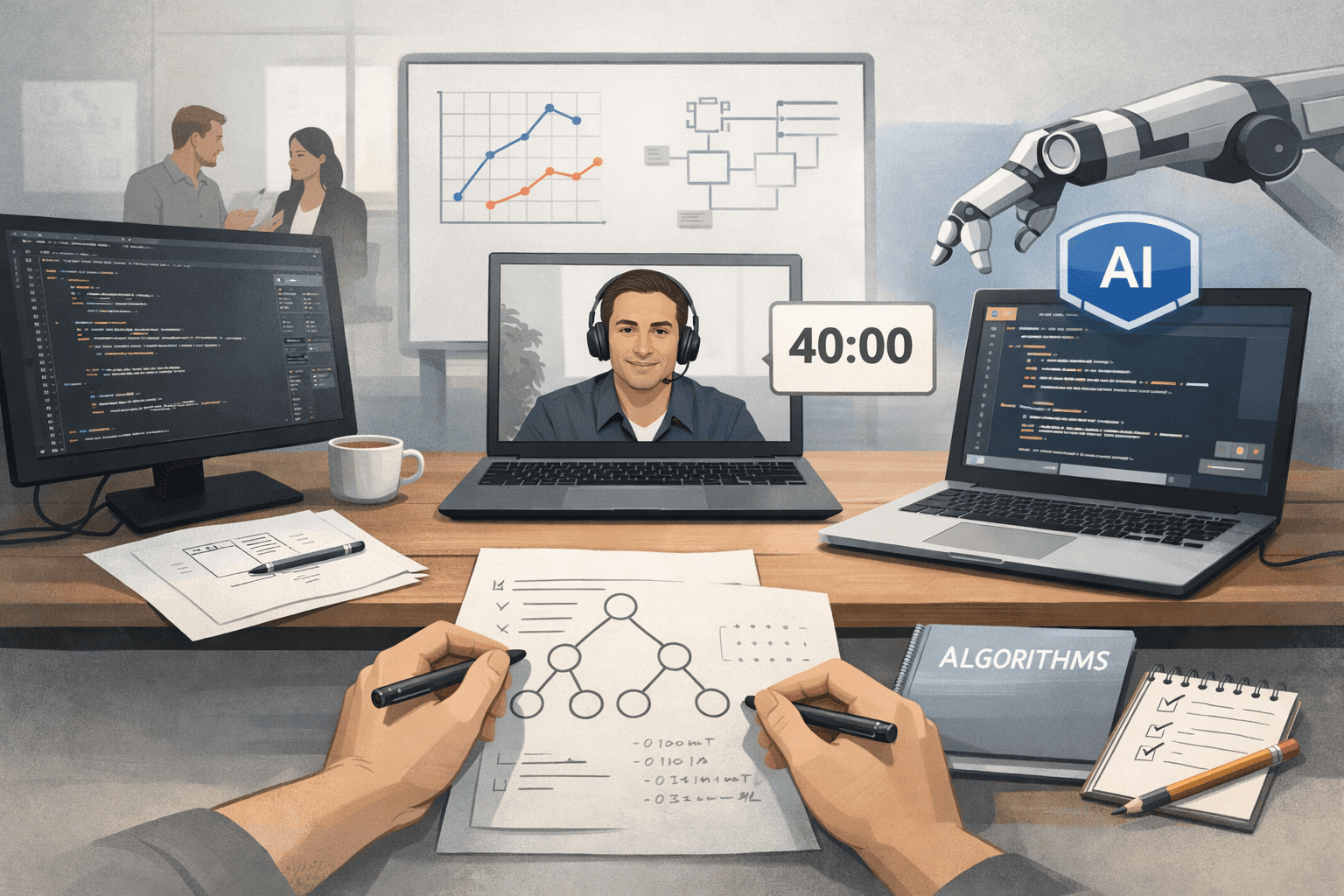
Algorithmic interviews have sparked ongoing debate. Critics argue they don’t fully reflect day-to-day engineering work. Writing production systems involves collaboration, debugging legacy code, and making long-term design decisions — not just solving isolated puzzles in 40 minutes.
At the same time, hiring at scale requires structure. With remote hiring now common and global talent pools expanding, companies need consistent evaluation frameworks. Algorithmic interviews provide that consistency. They may not measure everything, but they offer a standardized way to assess core reasoning skills.
The rise of AI tools and coding copilots is also reshaping the landscape. Developers today can generate boilerplate code instantly. That makes structured problem solving and conceptual understanding even more important. Companies increasingly want to see how candidates think, not just what they can autocomplete.
Whether the format evolves or not, one truth remains: algorithmic interviews reward preparation. They are not IQ tests. They are skill-based assessments that respond well to deliberate practice.
If they feel overwhelming now, that’s normal. With structured repetition, pattern recognition, and realistic practice, performance improves steadily.
Preparation beats panic. And algorithmic interviews — while challenging — are absolutely learnable.
FAQs
What is the purpose of algorithmic interviews?
Algorithmic interviews are designed to evaluate structured problem-solving ability under time constraints. Rather than testing real-world system building directly, they assess how clearly you can reason through unfamiliar problems, select appropriate data structures, analyze time and space complexity, and communicate your thinking step by step.
Are algorithmic interviews realistic?
This is debated. While many problems do not mirror daily production work, structured interviews provide consistency, scalability, and measurable evaluation criteria. They are less about replicating real tasks and more about testing fundamental analytical skills that transfer to engineering work.
How long should I prepare for algorithmic interviews?
Preparation time depends on your starting point. If you are already comfortable with core data structures and algorithms, 4–6 weeks of focused practice may be enough. If you are starting from scratch, a longer structured plan of 8–12 weeks is more realistic.
Do I need to memorize solutions?
No. Memorizing patterns without understanding rarely works in interviews. Instead, focus on recognizing problem categories (arrays, trees, graphs, dynamic programming), understanding why solutions work, and practicing explaining your reasoning clearly.
Can AI tools help with preparation?
Yes, when used strategically. Text-based AI tools can help clarify complexity analysis, review problem-solving approaches, and simulate follow-up questions. However, they should complement active problem solving rather than replace hands-on coding practice.
Are algorithmic interviews going away?
Unlikely in the near term. While hiring formats evolve, structured problem-solving under constraints remains a practical way to evaluate candidates at scale. The format may adapt, but the core skill it tests is still valuable.

Shin Yang
Shin Yang est un stratégiste de croissance chez Sensei AI, axé sur l'optimisation SEO, l'expansion du marché et le support client. Il utilise son expertise en marketing numérique pour améliorer la visibilité et l'engagement des utilisateurs, aidant les chercheurs d'emploi à tirer le meilleur parti de l'assistance en temps réel aux entretiens de Sensei AI. Son travail garantit que les candidats ont une expérience plus fluide lors de la navigation dans le processus de candidature.
En savoir plus
Série de tutoriels : Présentation de notre nouvelle extension Chrome Listener
AI Resource Shift Alert: 5 Silent Signs Your Tech Team Is Being Phased Out for AI Agents (And What to Do Today)
8 Corporate Alibis for Being “Away” on Teams/Slack (That Actually Make You Sound More Productive)
10 Clever Excuses to Skip a Zoom Meeting Without Looking Unproductive (2026 Tech-Proof Version)
Beyond Screen Recording: 7 Things Modern Coding Assessments Now Track (And How to Stay Calm)
12 “Digital Wellness” Reasons to Decline a Meeting (That HR and Your 2026 Calendar Can’t Flag)
The "Pre-Layoff" Checklist: 7 Subtle Signs Your Role is Being Automated Away (And How to Pivot Before the Announcement)
The Ghost Applicant Crisis: How to Get Your LinkedIn Message Read When Recruiters Are Buried Under AI Spam
12 Smart Ways Employees Are Declining Return-to-Office Orders in 2026
The Salary Bluff: How to Force Recruiters to Reveal the Real Pay Range Without Sounding Aggressive
Sensei AI
hi@senseicopilot.com