

Why Reverse Interviewing Matters More Than Ever
Reverse interviewing is no longer just a “nice-to-have” skill—it has become a critical part of standing out in modern hiring. Employers don’t just evaluate you anymore; they also pay close attention to how you evaluate them. This subtle shift changes the entire dynamic of an interview, turning it into a two-way conversation rather than a one-sided assessment.
When candidates ask thoughtful, strategic questions, it sends strong signals. It shows preparation, confidence, and genuine interest in the role and the company. On the other hand, weak, generic, or overly obvious questions can quietly damage your impression—even if you performed well in the earlier parts of the interview. Many candidates don’t realize that this final stage can influence hiring decisions just as much as their answers.
This shift is happening because hiring has become more balanced. Companies are no longer just looking for someone who can do the job—they want people who think critically, understand the bigger business context, and make intentional career decisions. Reverse interviewing gives you the opportunity to demonstrate all of these qualities naturally, without sounding rehearsed or overly polished.
In this guide, we’ll break down how to approach reverse interviewing effectively, what types of questions actually make an impact, and how to turn this often-overlooked moment into a real competitive advantage.
What Is Reverse Interviewing (And What It’s Not)
Reverse interviewing is the part of the interview where you ask questions to the interviewer. But it’s not just about filling time or showing curiosity—it’s about demonstrating how you think, what you prioritize, and how you approach decisions in a professional context.
Many candidates misunderstand this stage. They either ask safe but shallow questions that don’t add much value, or they try too hard to impress with overly complex or abstract questions that feel unnatural. Both approaches tend to fall flat because they don’t reflect genuine thinking or real engagement with the role.
The key difference comes down to intention. Strong candidates don’t treat this as an obligation—they treat it as an opportunity to extend the conversation and reinforce the impression they’ve already built.
What Reverse Interviewing Is
It’s a strategic opportunity to show how you think beyond surface-level responsibilities. Instead of asking questions just to ask something, you’re using this moment to highlight your awareness of the role and the company.
It allows you to:
Show business awareness by connecting your questions to real company goals
Demonstrate long-term thinking by focusing on growth and impact
Evaluate whether the role truly fits your expectations and career direction
When done well, your questions become a subtle way to position yourself as a thoughtful and intentional candidate.
What It’s Not
Reverse interviewing is not a checklist of random questions pulled from the internet. Asking disconnected or generic questions can make you seem unprepared rather than curious.
It’s also not the right moment to focus only on salary, benefits, or perks. While these are important, leading with them can signal that your priorities are short-term rather than role-focused.
Finally, it’s not a passive moment where you simply respond with “no questions” or ask something vague like “anything else you’d like to share.” This can come across as disengaged.
Strong candidates treat this stage as a continuation of the interview—not the ending. They stay intentional, engaged, and focused on creating a meaningful conversation.
Why Interviewers Pay Attention to Your Questions
Most candidates underestimate how much weight interviewers place on this part of the conversation. In reality, your questions can reshape their entire impression of you. Even if your answers were solid, this final stage can either reinforce your strengths—or introduce doubt.
Interviewers are not just listening to what you ask. They are paying attention to how you think, what you choose to focus on, and whether your priorities align with the role. In many cases, this is where candidates subtly differentiate themselves without realizing it.
What Your Questions Reveal
Your questions act as a window into your thinking process. Interviewers use them to evaluate several key dimensions of your candidacy:
How deeply you understand the role and its expectations
Whether you think beyond surface-level tasks and responsibilities
Your ability to identify and prioritize what actually matters
For example, asking about “success metrics” signals a sense of ownership and accountability. It shows that you are already thinking about how your performance will be measured.
Similarly, asking about “team challenges” reflects awareness. It indicates that you understand no role is perfect and that you are prepared to navigate real-world complexities rather than ideal scenarios.
These types of questions feel natural, but they carry strong underlying signals.
Hidden Signals Behind Great Questions
Great questions consistently communicate three things:
Strategic thinking, by connecting the role to broader goals
Curiosity with purpose, rather than asking for the sake of asking
Strong communication skills, through clarity and relevance
Instead of memorizing a list of “good questions,” it’s more effective to understand why certain questions work. This allows you to adapt naturally during the conversation.
At this stage, some candidates practice anticipating interviewer expectations using tools like Sensei AI. Since it listens to interviewer questions in real time and generates structured responses based on your background, it can also help you better understand how conversations flow—making your follow-up questions feel more natural rather than scripted.
Try Sensei Ai for Free
The 5 Types of Questions That Actually Impress
Not all questions are equal. Some may sound polite or safe, but they don’t leave a lasting impression. The strongest questions tend to fall into a few clear categories, each designed to reveal how you think, what you value, and how you approach your work.
Instead of memorizing random examples, it’s far more effective to understand these categories and adapt them naturally during the conversation.
1. Role Clarity Questions
Example:
“What does success look like in the first 90 days?”
Why it works:
This type of question shows that you are already thinking about impact and expectations. It signals that you care about delivering results early, rather than just understanding your responsibilities on paper. It also helps you gain a clearer picture of how performance is actually measured.
2. Team & Collaboration Questions
Example:
“How does this team typically collaborate on projects?”
Why it works:
This question highlights your awareness of team dynamics. It shows that you understand success is rarely individual and that collaboration plays a key role in achieving outcomes. It also gives you insight into communication styles and workflows within the team.
3. Challenge-Based Questions
Example:
“What are the biggest challenges someone in this role will face?”
Why it works:
This demonstrates realism and a problem-solving mindset. Instead of focusing only on the positives, you acknowledge that every role comes with difficulties. It shows that you are mentally prepared to handle obstacles and adapt when needed.
4. Growth & Development Questions
Example:
“What opportunities are there for learning and growth?”
Why it works:
This signals long-term thinking. It shows that you are not just focused on getting the job, but also on developing your skills over time. Employers often value candidates who are invested in continuous improvement and professional growth.
5. Business Impact Questions
Example:
“How does this role contribute to the company’s broader goals?”
Why it works:
This demonstrates strategic awareness. It shows that you are thinking beyond your immediate tasks and trying to understand how your work connects to larger business objectives. This type of perspective is often associated with stronger, more mature candidates.
Good vs Bad Questions (With Table)
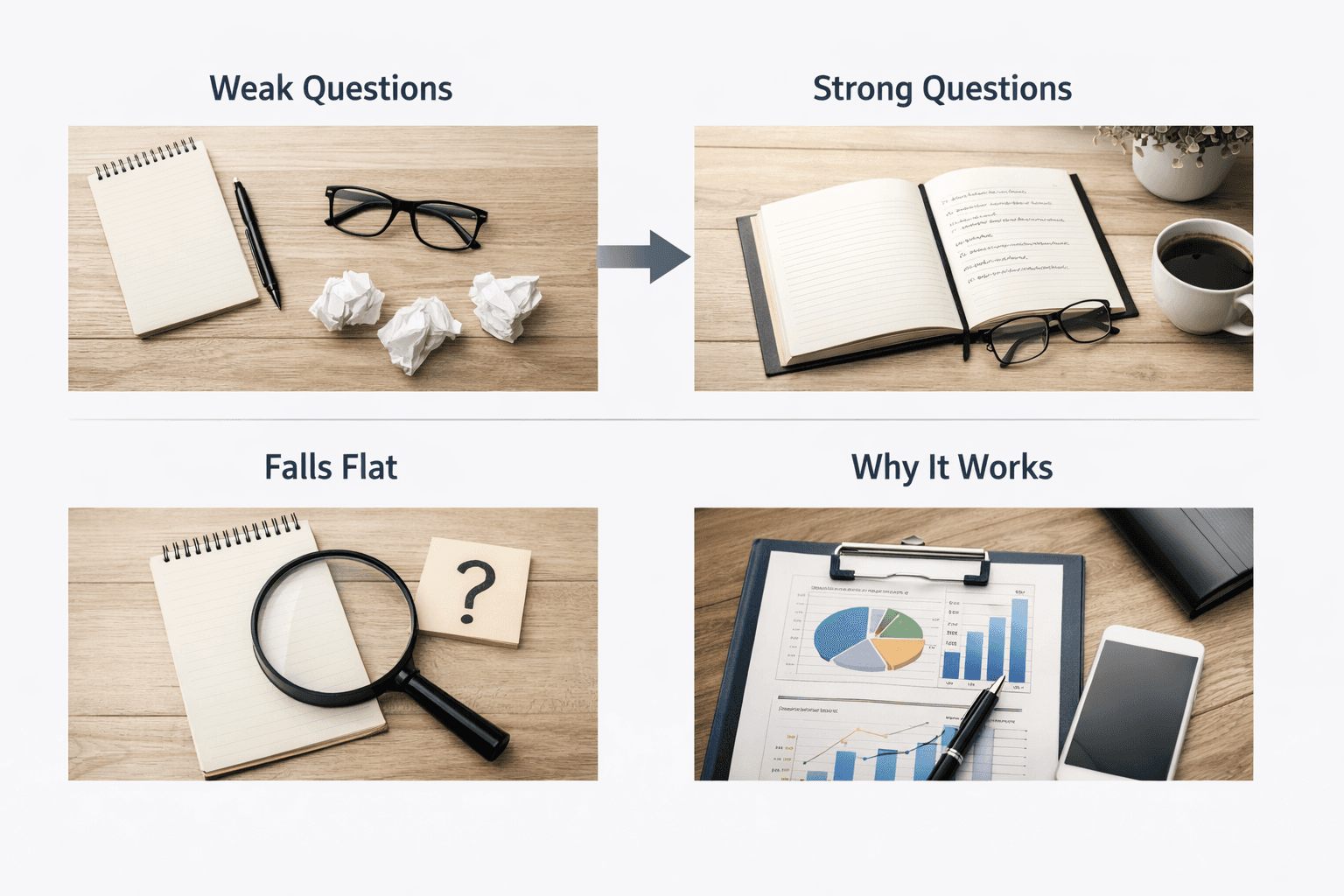
Some questions may sound acceptable on the surface, but they don’t actually add much value to the conversation. In many cases, the difference between a weak and a strong question is subtle—but it has a significant impact on how you are perceived.
Below is a comparison to help you see that difference more clearly:
Weak Question | Why It Falls Flat | Strong Alternative | Why It Works |
|---|---|---|---|
“What does your company do?” | Shows no research | “How is the company positioning itself in this market?” | Shows preparation |
“Is the team nice?” | Too vague | “How would you describe the team’s working style?” | More specific |
“Do you offer training?” | Generic | “How do employees typically develop new skills here?” | Thoughtful |
These examples highlight an important pattern. Weak questions tend to be generic, surface-level, or easily answered through basic research. Strong questions, on the other hand, are more intentional and open the door to meaningful discussion.
Key Insight
The difference isn’t complexity—it’s specificity and intent. Strong candidates don’t necessarily ask more complicated questions; they ask better-focused ones.
Instead of simply asking for information, effective questions are designed to:
Show that you’ve already done some level of research
Invite deeper, more insightful discussion
Build a natural, engaging conversation rather than a Q&A exchange
This shift in approach makes your questions feel more relevant and thoughtful.
Using tools like Sensei AI can also help refine how you phrase these questions. Since it generates structured answers based on real interview inputs, reviewing those responses can give you a clearer sense of how to align your follow-up questions with what interviewers actually care about—without overthinking the process.
Practice with Sensei Ai
How to Prepare Your Questions (Without Sounding Scripted)
Preparation is essential when it comes to reverse interviewing—but relying too heavily on memorization can actually work against you. When questions sound overly rehearsed, they can feel disconnected from the conversation and reduce your authenticity.
The goal is not to deliver perfect, pre-written questions. Instead, you want to prepare in a way that allows you to stay flexible, responsive, and natural during the interview.
Step 1: Start With Research
Good preparation begins before the interview even starts. Taking time to understand the company and the role helps you avoid asking questions that are too basic or easily searchable.
Focus on:
Company news and recent developments
The role description and key responsibilities
Broader industry trends and challenges
This level of preparation allows you to ask more informed and relevant questions, which immediately sets you apart from candidates who rely on generic prompts.
Step 2: Use a Flexible Framework
Instead of memorizing exact wording, prepare a small set of question themes. This gives you structure without making you sound rigid.
A simple approach is to prepare 5–7 questions across key areas:
Role expectations
Team dynamics
Growth opportunities
Business impact
During the interview, you can adapt these questions based on what has already been discussed. This keeps the conversation fluid and prevents repetition.
Step 3: Listen During the Interview
One of the most overlooked skills is active listening. In many cases, interviewers will already answer some of your prepared questions without you needing to ask them directly.
The best candidates:
Adjust their questions in real time
Ask thoughtful follow-up questions
Build on what the interviewer has already shared
This approach makes your questions feel more natural and conversational, rather than scripted or forced.
Common Mistakes to Avoid
Even strong candidates can make simple but costly mistakes during the reverse interviewing stage. These mistakes are often not obvious in the moment, but they can significantly affect how interviewers perceive your level of interest, preparation, and professionalism.
Being aware of these pitfalls can help you avoid them and approach this part of the interview with more intention and clarity.
Mistake 1: Asking Too Many Questions
It’s easy to assume that asking more questions will make you seem more engaged. However, this can backfire if your questions become repetitive or unfocused.
Quality matters far more than quantity. A few well-thought-out questions that spark meaningful discussion are much more effective than a long list of generic ones. Overloading the interviewer can also disrupt the natural flow of the conversation.
Mistake 2: Asking Only About Benefits
Focusing too much on salary, perks, or benefits can create the impression that your primary motivation is short-term gain rather than genuine interest in the role.
While these topics are important, they should not dominate your questions—especially in early-stage interviews. Instead, balance them with questions about responsibilities, challenges, and growth to show a more well-rounded perspective.
Mistake 3: Not Asking Anything
This is one of the biggest red flags in an interview. Choosing not to ask any questions can make you appear disengaged, unprepared, or uninterested in the opportunity.
Even one thoughtful, relevant question is better than none. It shows that you are actively thinking about the role and the company.
Some candidates use Sensei AI’s AI Playground to quickly test and refine their questions before interviews. Since it’s a text-based environment designed for interview and workplace scenarios, it can help you experiment with different phrasing and see how your questions might be interpreted—without needing a live interview setting.
Try Sensei Ai Now!
How Reverse Interviewing Can Help You Evaluate the Company
Reverse interviewing isn’t just about impressing the employer—it’s also about protecting your own career decisions. While many candidates focus entirely on performing well, the best ones also use this moment to evaluate whether the company is truly the right fit for them.
The questions you ask—and more importantly, the answers you receive—can reveal insights that are not always visible in job descriptions or company websites. This is your opportunity to look beyond surface-level information and assess the reality of the role.
What to Look For in Answers
When interviewers respond to your questions, pay close attention not just to what they say, but how they say it.
Look for:
Clarity vs vagueness in their explanations
Confidence vs hesitation when discussing responsibilities or expectations
Consistency in answers, especially if you speak with multiple interviewers
Clear and confident answers often indicate strong alignment within the team and organization. On the other hand, vague or inconsistent responses may suggest a lack of structure or unclear expectations.
These subtle signals can give you a much deeper understanding of the working environment than direct statements alone.
Red Flags to Watch
Certain patterns in responses can indicate potential issues within the role or company.
Examples include:
No clear success metrics for the position
Avoiding or downplaying questions about challenges
Overly generic responses that lack detail or specificity
While no company is perfect, consistent red flags should not be ignored. They can point to deeper issues such as poor management, unclear priorities, or unrealistic expectations.
A strong interview goes both ways. Just as the company is evaluating you, you should be equally thoughtful in evaluating them.
Turn Questions Into Your Competitive Edge

Reverse interviewing is one of the simplest yet most overlooked ways to differentiate yourself in a competitive hiring process. While many candidates focus heavily on preparing answers, far fewer put the same level of thought into the questions they ask.
The reality is, you don’t need perfect questions. You need intentional ones. Questions that reflect your thinking, your priorities, and your understanding of the role can leave a much stronger impression than polished but generic responses.
When done right, your questions can:
Reinforce your strengths without repeating your answers
Show how you think and approach real-world situations
Leave a lasting impression that goes beyond technical qualifications
Instead of treating this as the final step of the interview, think of it as your closing argument. It’s your chance to shape how the interviewer remembers you and to end the conversation with clarity, confidence, and purpose.
FAQs
What is a reverse interview?
A reverse interview is the part of the interview where the candidate asks questions to the interviewer. It’s an opportunity to demonstrate critical thinking, assess the role and company, and engage in a two-way conversation rather than a one-sided evaluation.
What are the 4 interview styles?
The four common interview styles are structured interviews (with standardized questions), unstructured interviews (more conversational), behavioral interviews (focused on past experiences), and situational interviews (focused on hypothetical scenarios).
What questions should I ask in a reverse interview?
You should ask questions that focus on role expectations, team dynamics, challenges, growth opportunities, and business impact. The goal is to show thoughtful engagement and gain meaningful insights rather than asking generic or surface-level questions.
What are the three types of interviews?
The three main types of interviews are behavioral interviews, technical interviews, and case or situational interviews. Each type evaluates different aspects of your skills, experience, and problem-solving ability.

Shin Yang
Shin Yang est un stratégiste de croissance chez Sensei AI, axé sur l'optimisation SEO, l'expansion du marché et le support client. Il utilise son expertise en marketing numérique pour améliorer la visibilité et l'engagement des utilisateurs, aidant les chercheurs d'emploi à tirer le meilleur parti de l'assistance en temps réel aux entretiens de Sensei AI. Son travail garantit que les candidats ont une expérience plus fluide lors de la navigation dans le processus de candidature.
En savoir plus
Série de tutoriels : Présentation de notre nouvelle extension Chrome Listener
Good Excuses to Leave Work Early: 25 Professional Reasons That Won't Hurt Your Reputation
Should Your Resume Sound Like ChatGPT? The Right Balance Between AI Writing and Authenticity
Resume Mistakes AI Notices Before Humans Do (And How to Fix Them Before You Apply)
Les pires conseils d'entretien auxquels les gens croient encore (et ce qui fonctionne vraiment à la place)
Ce que les recruteurs aimeraient que les candidats sachent : 11 secrets pour vous faire embaucher plus rapidement
LinkedIn Profile Checklist 2026: 27 Updates That Make Recruiters Want to Click "Message"
LinkedIn Profile Before vs After Examples: 15 Real Transformations That Attract Recruiters
Pourquoi les recruteurs vous interrompent : 10 vraies raisons (et comment y répondre sans perdre confiance)
The Hidden Metadata Recruiters Can See (And What It Really Says About You)
Sensei AI
hi@senseicopilot.com