
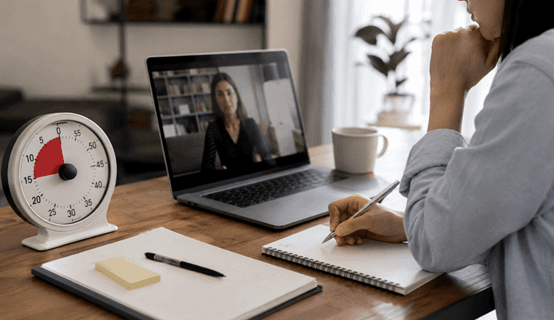
When You’re Down to 15 Minutes (Why Focus Beats Panic)
You open your laptop, check the time, and realize your Zoom interview starts in 15 minutes. There’s no space for deep research, no time to read long company reports, and definitely no chance to prepare perfect answers. This is where most people panic — but they shouldn’t.
In reality, last-minute preparation isn’t about trying to learn everything. It’s about choosing the right things to focus on. A focused 15 minutes can be surprisingly powerful if you use it well. The goal is not perfection — it’s relevance.
Most candidates make the same mistake in this situation. They rush into low-impact tasks like skimming entire company blogs, memorizing random facts, or trying to anticipate every possible question. It feels productive, but it rarely helps in the actual conversation.
Stronger candidates take a different approach. They prioritize high-signal insights — the small amount of information that directly improves how they answer questions, communicate clearly, and connect their experience to the role.
This guide is built for exactly that moment. Instead of overwhelming you, it gives you a sharp, practical checklist to help you walk into your interview focused, clear, and ready — even with just 15 minutes on the clock.

The 3 Things Interviewers Actually Care About
Most interviews feel unpredictable, but in reality, interviewers are usually evaluating just a few key dimensions. When you only have 15 minutes to prepare, understanding these priorities gives you a clear advantage.
What interviewers are really looking for
What you can do (skills and relevance)
They want to know if your experience matches the role and whether you can deliver results.
What you know about them (basic company awareness)
They’re checking if you made any effort to understand the company and how your role fits into it.
How you think (communication and clarity)
Your ability to explain ideas clearly often matters as much as the ideas themselves.
This is why your 15-minute preparation should map directly to these three areas. Instead of trying to cover everything, you focus only on what moves the needle during the interview.
How to translate this into quick prep
What Interviewers Evaluate | What You Should Prep in 15 Minutes |
|---|---|
Skills and relevance | One strong example story |
Company knowledge | 2–3 key facts |
Communication and thinking | Clear, structured answers |
This simple alignment helps you avoid wasted effort and stay focused on impact.
Now that you know what actually matters, the next step is breaking down exactly what to research — and how to use each minute effectively.
Minute 0–5: Understand the Role (This Matters More Than the Company)
When time is limited, understanding the role is far more valuable than researching the company in depth. The role defines what you will actually be asked about, how your experience will be evaluated, and what kind of answers will resonate. If you only get one thing right in your preparation, make it this.
What to do in the first 5 minutes
Scan the job description quickly
Don’t read every line. Focus on the parts that describe responsibilities and expectations.
Identify 2–3 core responsibilities
Look for patterns. What are they hiring this person to actually do on a daily basis?
Spot repeated keywords (tools, skills, outcomes)
If certain skills or tools show up multiple times, they are likely critical to the role.
A simple way to turn this into answers
Use this quick framework: Highlight → Match → Prepare
Highlight the most important requirements
Match them to your past experience
Prepare one example that clearly demonstrates each match
For example, if “stakeholder communication” appears multiple times, prepare one concise story where you coordinated across teams, handled expectations, or delivered updates effectively.
This approach keeps your preparation focused and practical. You are not trying to memorize answers — you are aligning your experience with what they actually need.
Tools like Sensei AI can support this process by referencing your resume and role details to generate tailored answers in real time during interviews. This can be especially helpful when you don't have time to fully prepare and need structured responses quickly.
Try Sensei AI for Free
Minute 5–10: Learn Just Enough About the Company
At this stage, your goal is not deep research — it is minimum effective research. You want just enough understanding to sound informed, relevant, and intentional without wasting precious time.
What to check quickly
Company homepage headline
This usually tells you how the company positions itself and what it prioritizes.
What the company actually does (in plain English)
Be able to explain it simply, as if you were describing it to someone outside the industry.
Recent news or major updates
Look for expansions, product launches, or strategic shifts.
Industry category
Understand where the company sits and who it might compete with.
Good vs Bad Research
Type of Research | Example |
|---|---|
Good | They recently expanded into AI-driven analytics |
Bad | Founded in 2012, headquartered in… |
The difference is simple: good research helps you say something meaningful, while bad research is just memorized trivia. Interviewers rarely care about facts unless you can connect them to your role.
Surface-level memorization becomes useful only when it supports your answers.
A simple way to connect the dots
Use this formula: What they do + Why it matters + How it connects to my role
For example: explain the company’s product, why it is relevant in the market, and how your skills contribute to that mission.
If you are unsure how to turn company information into strong talking points, Sensei AI’s AI Playground can help generate quick, role-specific ideas before the interview. It is a simple way to bridge the gap between research and actual answers.
Practice with Sensei AI
Minute 10–13: Prepare 2 High-Impact Stories

When time is tight, stories matter far more than facts. Interviewers rarely remember isolated details, but they do remember clear, specific examples of what you have done. A well-told story shows your skills, your thinking, and your impact all at once.
Focus on just two stories
One achievement story
Pick something where you delivered a strong, measurable result.
One challenge or problem-solving story
Choose a situation where things were unclear, difficult, or required initiative.
These two stories are enough to cover a surprising range of interview questions.
Keep your structure simple
Use a lightweight flow: Situation → Action → Result
You do not need to sound robotic or overly structured. This is just a way to stay clear and avoid rambling.
Example:
In my previous role, our team faced delays due to unclear communication between departments. I introduced a weekly alignment process and simplified reporting. As a result, project delivery time improved by 20 percent within two months.
Clarity beats perfection
Do not try to craft the “perfect” story. Focus on being easy to follow, specific, and relevant. A simple, clear story will always outperform a complex but confusing one.
Make your stories flexible
The real advantage of preparing two strong stories is adaptability. The same example can be used to answer questions about teamwork, leadership, conflict, or problem-solving — you just shift the emphasis slightly depending on the question.
At this stage, avoid overpreparing. You do not need multiple versions or memorized scripts. You only need to be comfortable telling your story clearly and confidently.
Minute 13–15: Prepare Your Opening and One Smart Question
In short interviews, first impressions carry disproportionate weight. You may only have a limited window to speak, so how you start often shapes how the rest of the conversation is perceived. A clear, confident opening can immediately signal that you are prepared, even if you only had 15 minutes.
What to prepare in the final minutes
A 20–30 second introduction
This is your chance to frame your background and set the direction of the conversation.
One thoughtful question to ask the interviewer
This shows curiosity, awareness, and genuine interest in the role.
A simple structure for your introduction
Use this formula: Who you are + What you’ve done + Why this role
For example, briefly mention your current role or background, highlight one relevant experience, and connect it directly to why you are interested in this position.
Examples of strong questions
“What does success look like in the first 3 months?”
“What challenges is the team currently facing?”
These questions are effective because they shift the focus toward impact and contribution, rather than generic curiosity.
Even with minimal preparation time, this approach makes you come across as focused and intentional. It shows that you understand what matters and are thinking ahead.
During the actual interview, Sensei AI can support you by detecting interviewer questions and generating structured responses in real time. This helps you stay clear, relevant, and confident, especially when you are under time pressure.
Try Sensei AI Today!
What NOT to Do in Those 15 Minutes
When you only have 15 minutes, what you avoid is just as important as what you do. Many candidates waste this window on activities that feel productive but deliver very little value during the interview.
Common mistakes to avoid
Reading too much
Going through long articles, blogs, or reports may feel thorough, but it rarely translates into better answers.
Memorizing scripts
Trying to rehearse perfect answers often leads to sounding unnatural and rigid under pressure.
Over-focusing on company history
Details like founding dates or office locations do not help you demonstrate relevance or impact.
Trying to prepare for every possible question
This creates stress and spreads your attention too thin, leaving you unprepared for what actually matters.
Why these approaches don’t work
These are all low return-on-investment activities. They consume time without improving your ability to communicate clearly, connect your experience to the role, or respond effectively in real time.
A better way to think about preparation
Preparation is about leverage, not completeness. You are not trying to cover everything — you are focusing on the few things that will have the biggest impact during the conversation.
A focused 15 minutes will always outperform a scattered one. Cut the noise, prioritize what matters, and use your time with intention.
The 15-Minute Checklist (Quick Recap You Can Screenshot)
When time is tight, having a simple checklist helps you stay focused and avoid overthinking. This is your quick, practical recap of how to use each minute effectively. Instead of jumping between tasks, follow this sequence and commit to moving forward once each step is done.
Your 15-minute plan
Time Block | What to Focus On | What to Do |
|---|---|---|
Minute 0–5 | Role understanding | Scan job description, identify 2–3 core responsibilities, spot key skills |
Minute 5–10 | Company basics | Check homepage, understand what they do, note 1–2 relevant updates |
Minute 10–13 | Two key stories | Prepare one achievement and one problem-solving example |
Minute 13–15 | Intro and question | Craft a short intro and prepare one thoughtful question |
This structure keeps your preparation intentional and efficient. Each step builds directly toward improving how you perform in the interview, not just how much you know.
If you feel rushed, remember that clarity beats quantity. Stick to the essentials, trust the process, and focus on communicating what matters most.
You Don’t Need More Time, You Need Better Focus

It is easy to believe that more preparation time leads to better performance, but that is not always true. What actually makes a difference is how you use the time you have. Even 15 minutes can be enough if you focus on the right things.
Most candidates are less prepared than they appear. They may have spent hours reviewing information, but still struggle to communicate clearly or connect their experience to the role. That is where focused preparation gives you an edge.
By prioritizing role understanding, essential company context, clear stories, and a strong opening, you position yourself to perform well under pressure. You are not trying to be perfect — you are aiming to be relevant, clear, and confident.
In the end, interviews reward clarity, relevance, and communication far more than perfect preparation. Use your time wisely, trust your experience, and walk into the conversation ready to make your points count.
FAQs
What if I have less than 15 minutes before an interview?
If you have even less time, narrow your focus further instead of trying to rush everything. Prioritize understanding the role and preparing one strong, flexible story that highlights your most relevant experience. This alone can carry a large portion of the interview, especially for behavioral questions.
Make sure you can clearly explain what you did, why it mattered, and what the outcome was. Even with minimal preparation, a well-delivered example often leaves a stronger impression than scattered knowledge.
Is it okay to say I didn’t have time to research?
It is generally not a good idea to say this directly. Instead, focus on demonstrating what you do know and use that to guide the conversation. Even a basic understanding of the company and role can go a long way if you communicate it clearly.
You can also ask thoughtful questions to show curiosity and engagement. This shifts the focus from what you missed to how you think, which is often more important.
How much company knowledge is “enough”?
You do not need deep or detailed knowledge. It is enough to explain what the company does in simple terms and connect it to your role in one or two sentences.
For example, you should be able to describe their main product or service, why it matters in the market, and how your skills contribute to that. Anything beyond that is helpful but not essential in a short preparation window.
Can AI tools replace interview preparation?
AI tools cannot replace preparation entirely, but they can support you in meaningful ways. Tools like Sensei AI provide real-time, structured responses during interviews based on your background and role details.
However, you still need a basic understanding of your experience and the position. Clear thinking, relevance, and communication remain your responsibility, with AI acting as a support rather than a substitute.

Shin Yang
Shin Yang est un stratégiste de croissance chez Sensei AI, axé sur l'optimisation SEO, l'expansion du marché et le support client. Il utilise son expertise en marketing numérique pour améliorer la visibilité et l'engagement des utilisateurs, aidant les chercheurs d'emploi à tirer le meilleur parti de l'assistance en temps réel aux entretiens de Sensei AI. Son travail garantit que les candidats ont une expérience plus fluide lors de la navigation dans le processus de candidature.
En savoir plus
Série de tutoriels : Présentation de notre nouvelle extension Chrome Listener
Sensei AI vs Interviewing.io: Which Interview Tool Is Better for You in 2026?
Sensei AI vs Huru: Which AI Interview Tool Is Better in 2026?
Sensei AI vs Interview Warmup: Which Interview Practice Tool Is Better in 2026?
How Recruiters Detect AI Answers (and How to Stay Authentic)
Interview Copilot vs Traditional Interview Coaching: Which Is Better for Your Next Interview?
Best AI for Behavioral Interview Questions: 9 Tools to Practice Smarter in 2026
Google Interview Warmup Alternatives: 9 Best Tools to Practice for Interviews in 2026
How to Practice for an Interview by Yourself: A Step-by-Step Guide That Actually Works
Best AI Tools for Job Seekers in 2026
Sensei AI
hi@senseicopilot.com